The Priest Who Discovered the Big Bang
A dramatized first-person retelling of documented events
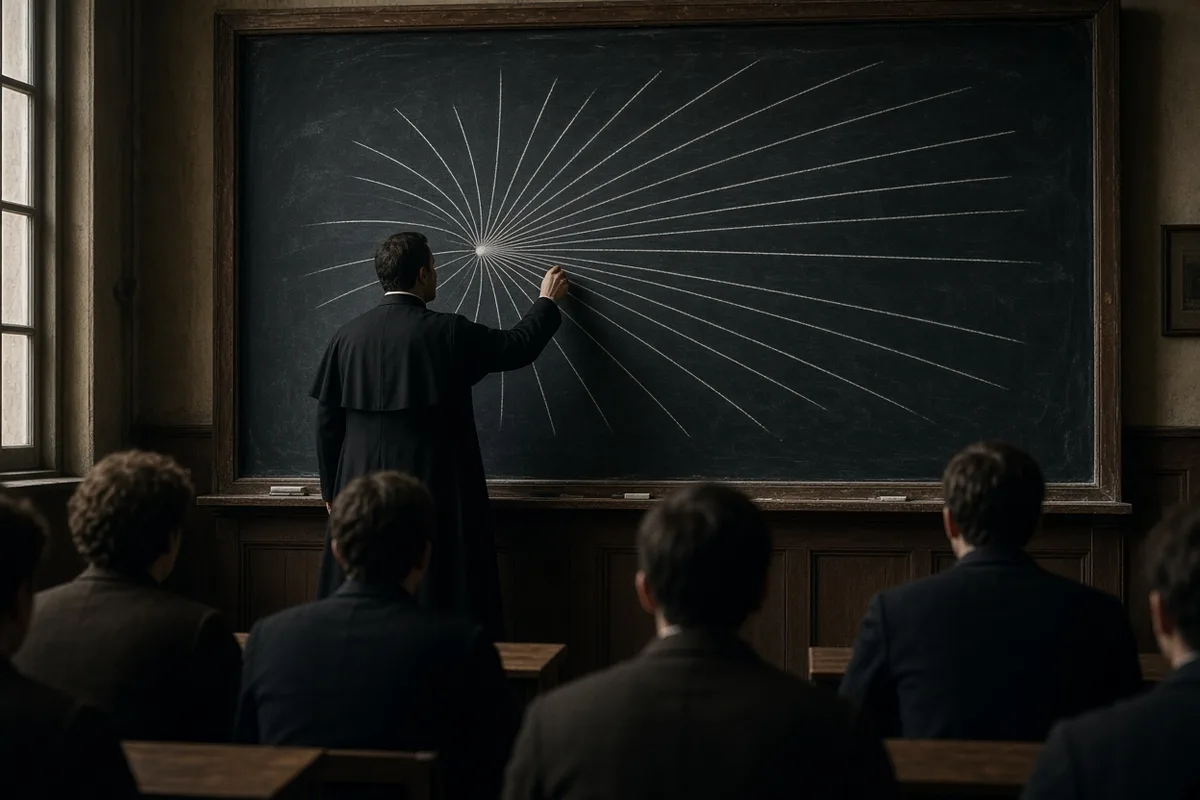
The breech was still hot when Georges leaned over the firing table with a pencil stub and told the gun captain the manual was wrong. I remember the cold on my hands that morning, the smell of cordite hanging low over the position, and the flat disbelief on the officer's face when this artillery corporal — a seminarian's face on a soldier's body — pointed at a column of figures and said the trajectory tables did not add up. He was right. The correction went up the chain. The reprimand came down just as fast, because you do not tell an officer his manual is broken, even when it is. I served beside him through those years of mud and range-finding, and I can tell you the war did not blunt him. If anything it sharpened something in him that never went dull again.
He had come to it, like the rest of us from that country, sideways. Georges was a Charleroi boy, born in July of 1894 in a town built on coal seams and blast furnaces, the kind of place where a clever son was steered toward mining engineering the way water is steered downhill. He'd gone through the Jesuits at the Collège du Sacré-Coeur, all Latin declensions and disciplined hours, and by 1911 he was enrolled at the Catholic University in Louvain as an engineering student, headed, everyone assumed, toward the pits and the furnaces that had made the town. Then the guns started in August of 1914, and engineering waited.

He came home from the artillery with a decoration pinned to his chest and a mind that had gone somewhere the mining companies could not follow. Physics. Mathematics. He finished a degree in both by 1920, and then he did something that surprised even those of us who thought we knew him: he walked into the seminary at Malines for men called late to the priesthood. I asked him once, only half joking, whether the war had driven him to God or to differential equations, and he looked at me like the question made no sense, because to him they had never been two roads. He was ordained in 1923. From then on we called him Abbé Lemaître, and the title never once slowed him down.
He left for Cambridge that same year, on a fellowship, to sit under Arthur Eddington and learn the mathematics of a universe that bent under its own weight. Einstein's general relativity was still strange furniture to most physicists then, a house nobody had finished walking through. Eddington had proved light itself would bend around the sun; Georges wanted to know what the equations said about the shape of everything, not just the light passing near one star. I got letters from him in that Cambridge year, dense with symbols I could not follow, buoyant in a way his letters from the front had never been.
From England he crossed to America, first briefly to Canada, then to the Harvard College Observatory, where Harlow Shapley kept the great plates of the sky and the calculations that went with them. Harvard had no doctoral program of its own to give him, so he registered just down the road at the Massachusetts Institute of Technology to finish the degree properly. He haunted both buildings at once, and by his own account those years in Cambridge, Massachusetts, mattered as much to him as the ones in Cambridge, England, had. It was there, piecing a dissertation together, that the shape of his later work first showed itself, though none of us, him included, quite knew yet what it would become.
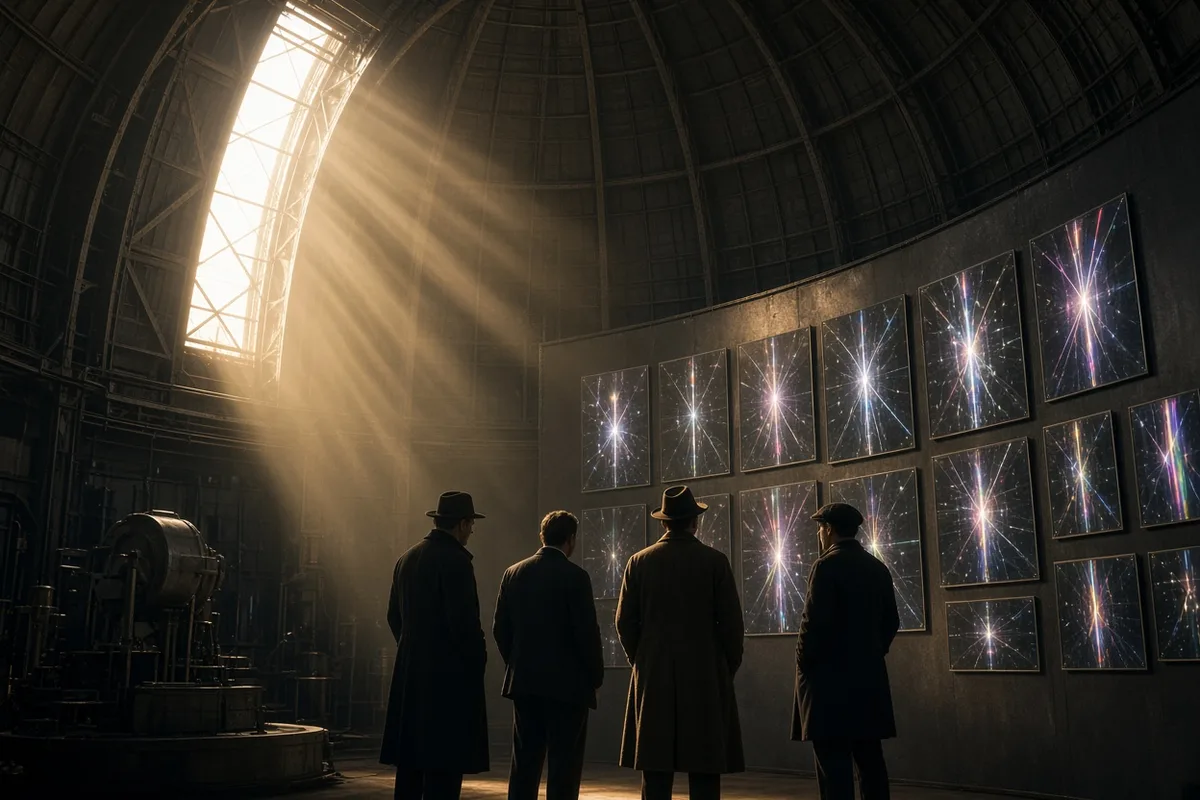
What he was gathering, without at first seeing the single thread through it, were facts other men had measured for other reasons. In 1925 word reached him of Edwin Hubble's distances to the spiral nebulae, proof they lay far outside the Milky Way, whole island systems of stars in their own right. He went out to California, to Caltech, and sat with Robert Millikan talking about cosmic rays raining down from beyond the atmosphere. He traveled to the Lowell Observatory in Arizona and learned what Vesto Slipher had spent years measuring with a patient spectroscope: the light from those distant nebulae was shifted toward the red, as if every one of them were running from us.
I picture him on the train back east with all of that rattling in his head at once — distances from Hubble, redshifts from Slipher, the elastic geometry of Einstein's equations from his own hard-won mathematics — and something in him simply closing the circuit. If the universe obeyed those equations, and if the galaxies really were retreating, the retreat was not an accident of a few unruly nebulae. It was the fabric itself stretching. And if it was stretching now, it had been smaller before, and smaller before that, all the way back to something almost unthinkable: everything that exists compressed into a single, dense point, what he would later call the primeval atom.
He wrote it up in French and sent it to a modest Belgian journal, the Annals of the Scientific Society of Brussels, in 1927. There was no fanfare. It sat there, this quiet paper with its section proposing a straight-line relationship between a galaxy's distance and the speed of its retreat, a number near six hundred kilometers per second for every megaparsec, and almost nobody outside Belgium read it. I remember him shrugging about it more than complaining, the way a man shrugs about a good letter that got lost in the post.
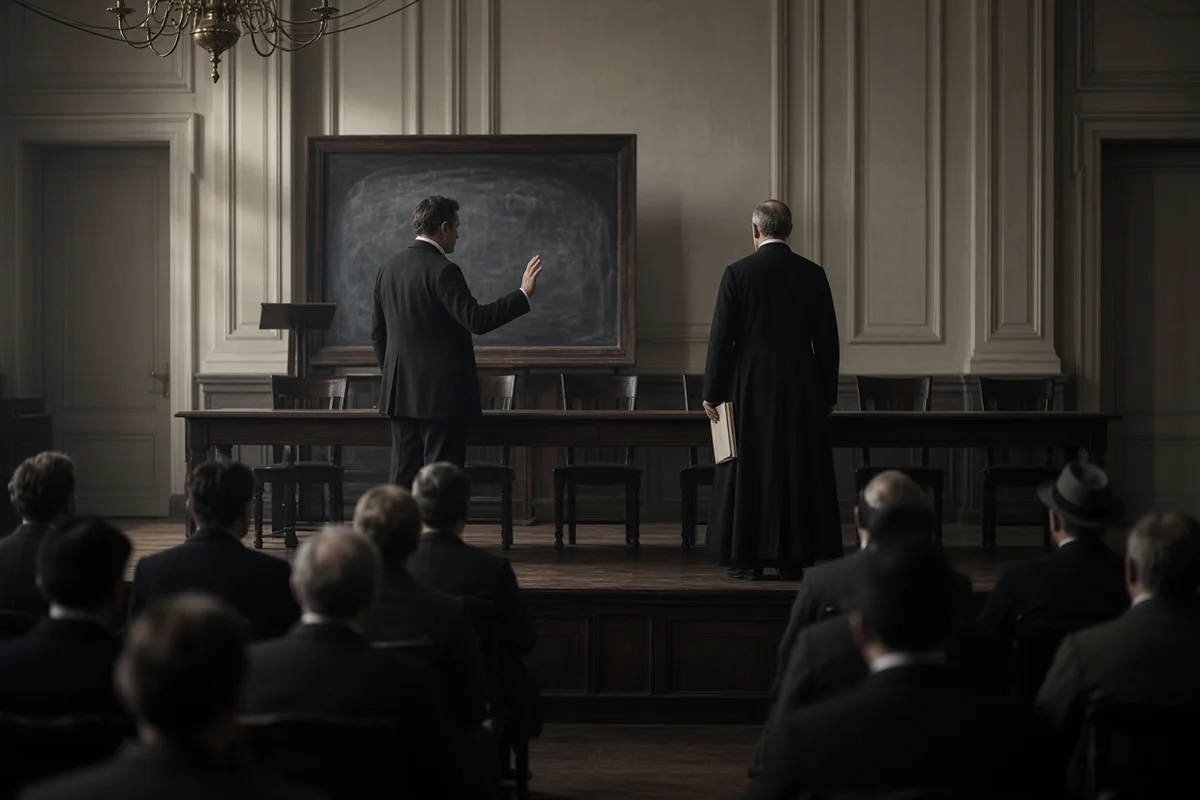
That same autumn the Solvay Conference gathered in Brussels, and the great men of physics filled a room together — Einstein among them, Bohr, Marie Curie, Heisenberg, the whole roster that made the newspapers when it traveled anywhere. Georges was young enough, and Belgian enough, to be at the edges of it, but he found his way to Einstein, and the two of them talked cosmology while more official business waited. I heard from more than one man in that room that Einstein was polite about the mathematics and unconvinced by the physics — abominable was the word that came back to me, though I did not hear it myself — because to Einstein an expanding universe still felt like an offense against a settled cosmos. Georges did not flinch from that. He simply kept working.
Two years later, in 1929, Hubble published his own velocity-distance relation, built from his own galaxies and his own plates, and the astronomical world seized on it the way a room seizes on the person who happens to be standing under the light when the idea finally lands. Hubble's law, they called it, and they still mostly do. Georges never made a public grievance of the timing. When Eddington arranged for the 1931 paper to be translated and reprinted in English, in the Monthly Notices of the Royal Astronomical Society, Georges went back over his own manuscript and quietly cut the velocity-distance section out of it, on the grounds that his old numbers were stale next to newer measurements. I asked him once why he hadn't fought harder to keep his name on it. He said the data mattered more than the name attached to it. I did not entirely believe him, but I let it go, because arguing cosmic priority with Georges Lemaître was like arguing with a man about the color of his own coat.
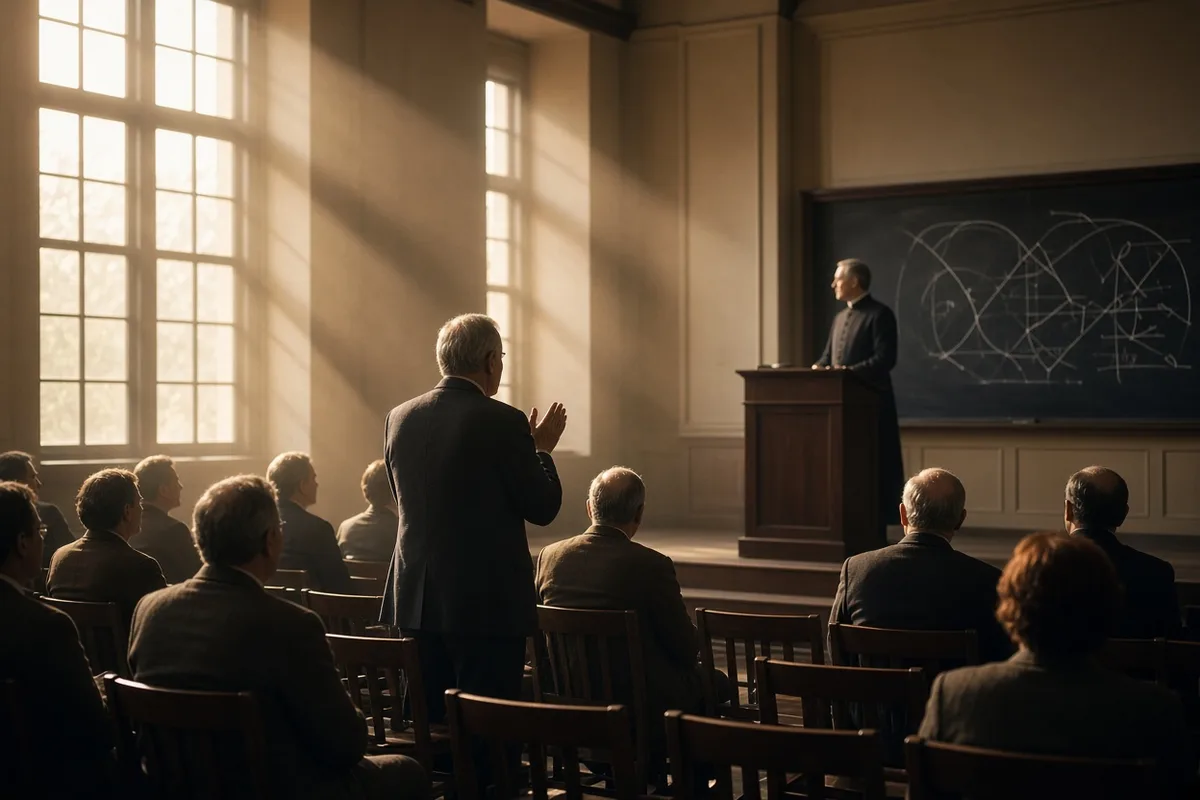
What he kept, and pushed further, was the primeval atom itself — not just an expanding universe but a universe with a beginning, a single dense seed unpacking itself into galaxies and stars and light. By 1933 he had carried the idea to California again, lecturing on it, and it was there, by every account that reached me afterward, that Einstein stood up in the audience and said it was the most beautiful and satisfying explanation of creation he had ever heard. I have turned that sentence over in my mind for years. The same man who once called the theory abominable, calling it beautiful six years later, because Georges had simply kept refining it until the mathematics carried the conviction the physics still lacked.
He went home to Louvain and stayed there for the whole of his career, a professor who never chased a grander chair elsewhere. His life outside the lecture hall ran on its own strict clock, one most of his students never fully saw. He belonged to a fraternity of priests called the Amis de Jésus and had made vows within it — poverty, chastity, obedience — on top of the ordinary obligations of the priesthood. Every day held an hour of silent prayer that nothing was permitted to crowd out, and every year held ten days of retreat in total silence, no equations, no colloquia, nothing but that. In America he had said Mass regularly at St. Paul's near Harvard; back in Belgium he threw himself into chaplaincy work among the Chinese students at Louvain, having taken the trouble, years earlier, to actually learn their language rather than merely tolerate the distance between them. I never once heard him describe any of this as a balancing act between two competing loyalties. To him the hour of prayer and the hour with the field equations were simply two rooms in the same house, and he walked between them without ceremony.
The war that came in 1940 pressed down on all of Louvain, and I watched him hold the physics department together on almost nothing — staff paid wages that would not have covered bread, equipment aging past repair, students disappearing into the chaos beyond the walls. He kept the work alive anyway, teaching whoever showed up, publishing what could be published, refusing to let the discipline simply lapse until better years returned. When they did return, he turned a good part of his remaining energy toward something almost nobody expected from him: the raw machinery of computation. He and his students built one of the first computer laboratories in Belgium, wrestling with celestial mechanics and the paths of charged particles through the Earth's magnetic field, problems that could only be cracked by grinding through numbers faster than any hand could manage. The man who had first imagined the universe as a single point spent his later years teaching machines to count.
In 1936 he had been named a founding member of the Pontifical Academy of Sciences, and in the spring of 1937 he signed its guest book at the Vatican Observatory alongside men like Hugh Stott Taylor and Peter Debye, the day before the Academy's formal inauguration. He would eventually become its president, in 1960, a position that suited a man who had never separated the roof over the chapel from the roof over the observatory. I was in the room in 1951 when Pope Pius XII addressed the Academy and spoke of science bearing witness, in his words, to that primordial Fiat Lux — let there be light — reaching for Georges's own cosmology as confirmation of Genesis. I watched Georges's face during that speech, and it was not the face of a man being vindicated. It was the face of a man uneasy at having his careful mathematics pressed into service as proof of scripture, because he had spent his whole working life insisting the two inquiries ran on separate tracks, neither needing the other's permission to be true.
He never stopped believing that. Faith did not require the primeval atom, and the primeval atom did not require faith, and if you tried to fuse them into one argument he would gently, firmly, take them back apart. It was, I think, the most stubborn thing about him, more stubborn than the pencil stub at the gun position all those years before, and it cost him some easy glory, because a scientist willing to let the Pope claim his equations as proof of creation would have had an easier road to the history books than one who kept insisting the equations proved nothing about God one way or the other.
He died on the twentieth of June, 1966, back in Charleroi, the mining town that had once expected him to spend his life underground pulling coal out of the earth instead of pulling the origin of the universe out of a column of figures. I think about that sometimes, the coal seams and the blast furnaces of his childhood, and the different kind of pressure and heat he ended up describing instead, packed into a point smaller than an atom's nucleus, waiting to unpack itself into everything that would ever exist.
It took the wider world a long time to give him his due. Hubble's name went on the law and stayed there for most of a century, while Georges's own 1927 paper, with its own version of that same velocity-distance relation, sat quietly in its Belgian journal, three years earlier and mostly unread. Only decades after he was gone did the International Astronomical Union, meeting in Vienna, put the question to its members and let them vote on adding his name where it had always belonged: the Hubble–Lemaître Law. I was not there for the count. But I like to think of that ballot landing, somewhere, on a desk not unlike the firing table where a young corporal once found the error nobody else had thought to check, and getting it right, at last, on the second try.