Take Up and Read: Augustine in the Garden
A dramatized first-person retelling of documented events
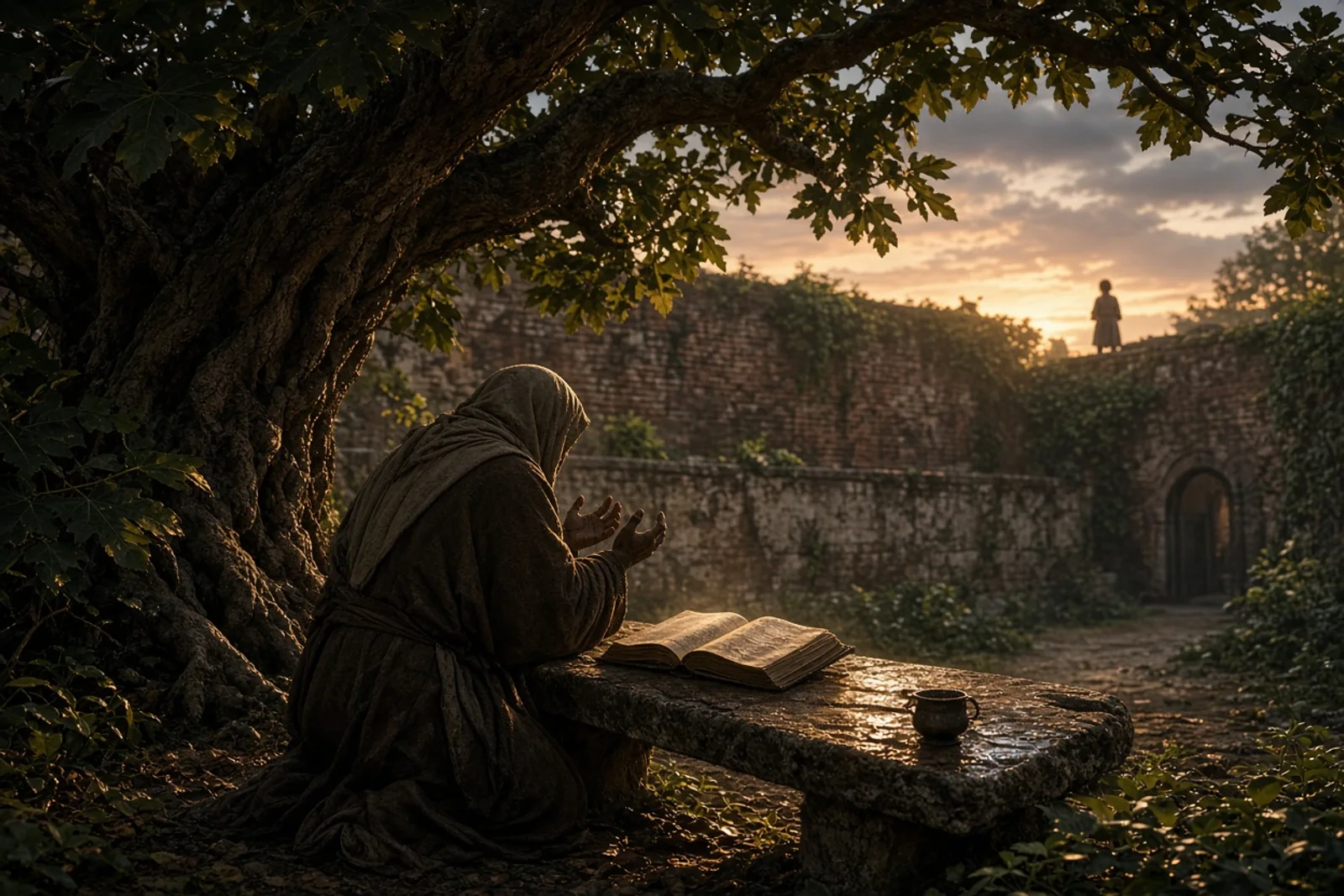
The wailing came through the garden wall before I understood whose voice it was. I had been drawing water at the well behind the kitchen, and for a moment I thought some stranger had wandered into the grounds to grieve, the sound was so raw, so unguarded. Then I recognized the cadence under the sobbing — the same voice that argued philosophy at supper, that could turn a Roman magistrate's ear with a single well-placed clause. It was Augustine, the rhetoric master, on his knees somewhere among the fig trees, tearing at something inside himself that no one in that house had ever seen him admit to owning.
We had watched him for months by then, all of us who kept that household running in Milan — the cook, the boy who tended the horses, myself with my buckets and baskets. He was the most talked-of tutor in the city, brought west from Carthage and then from Rome on the strength of his tongue alone, a man who could make an audience believe whatever he chose to prove that hour. But underneath the polish he was a man at war with himself, and by that late summer of 386 the war had come out into the open where even the kitchen staff could hear it.

He had not always fought so hard against himself. In his younger years, by his own telling, Carthage had been a city that boiled with temptation, and he had waded in gladly — a mistress before he was even a man grown, a son born of her, nights he later called, in words I heard him repeat more than once with a kind of bitter wonder, a cauldron of unholy loves sizzling and crackling around him. He had wanted truth the way other young men wanted glory, chasing it first through Cicero and the old Latin orators, certain that eloquence and reason together would deliver it to him. Christianity he had dismissed outright in those years, a faith fit for the simple and the credulous, not for a mind like his.
So he had gone looking elsewhere, and for nine years he found what he thought was an answer in the Manichees, who taught him that the world split cleanly down the middle, light against dark, spirit against flesh, and that a man's evil was not fully his own doing but the dark half warring in him. It fit his troubles conveniently. But when the great teacher of that sect could not answer the hard questions Augustine finally worked up the courage to ask him, the whole structure went hollow in his hands, and he drifted next toward the Neoplatonists, chasing truth again through a different door.

All this happened while his feet carried him steadily north and west — Carthage to Rome, Rome to Milan — always teaching, always persuading, never settling. And it was in Milan that his mother caught up with him. Monica had prayed over that man since before he could speak a word, a devout woman married to a pagan official who never shared her faith, and she had followed her son across the sea rather than let him wander without her prayers reaching him. I saw her often that summer, kneeling in the small chapel near the house, and I never once heard her voice raised, only low and constant, the way water wears stone.
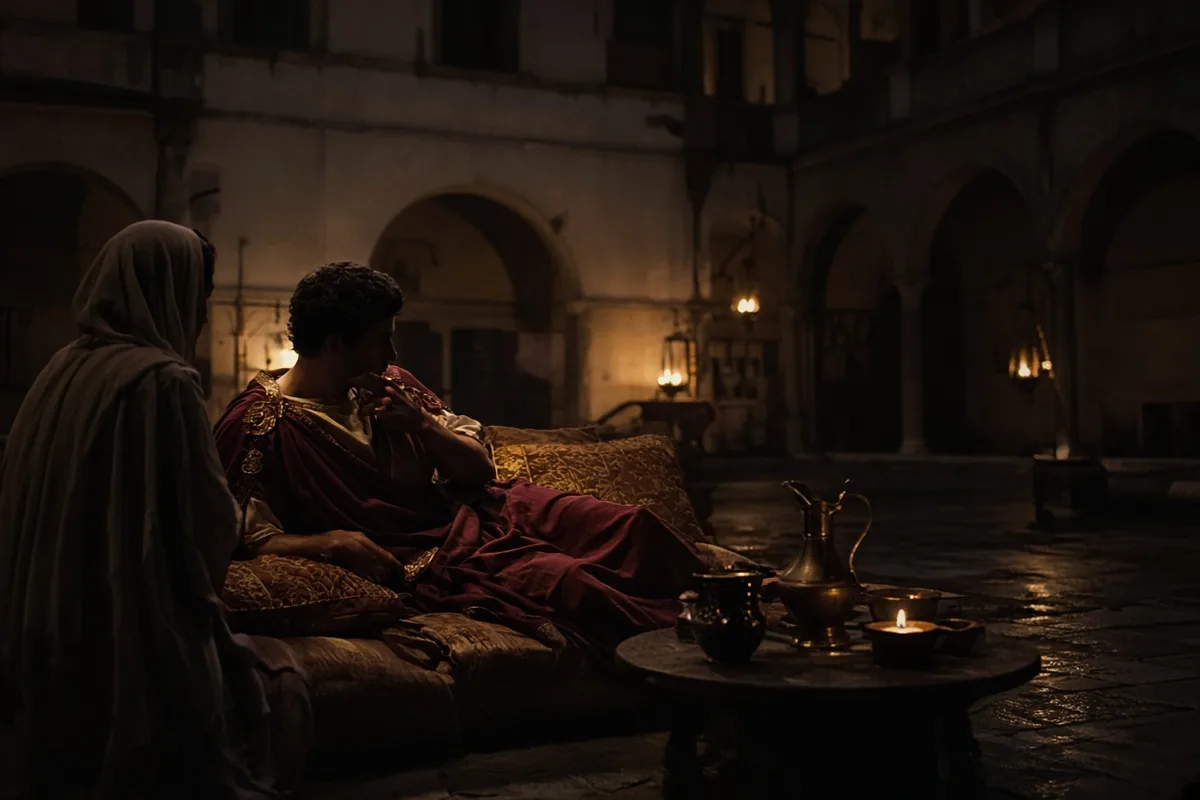
It was in Milan, too, that he met the bishop, Ambrose, and something in that meeting cracked the ground under him for good. Augustine had gone to hear him first for the man's famous eloquence, the way another rhetorician might size up a rival craftsman. He left disarmed instead. Ambrose answered the objections to Scripture that Augustine had been nursing for years, turned them over and showed him they weren't as solid as they'd looked, and alongside that he told him of others — men who had once burned with the same appetites Augustine carried and had laid them down entirely, given themselves over, and lived free of them. That combination worked on him like nothing else had: a faith serious enough for a serious mind, strong enough to loosen a grip that reason alone had never broken.

By the time that late summer day arrived, he was a man split down the center, and everyone near him could feel the strain of it. I had heard him once, half joking and half in earnest, throw up a kind of prayer to whatever God might be listening — asking to be made chaste, but not yet, not just yet — and laugh afterward in a way that did not sound like laughter. He wanted the thing and could not make himself want it enough to let go of the rest. That was the shape of him walking into the garden that afternoon: a brilliant man cornered by his own longing, with nowhere left to argue his way out.
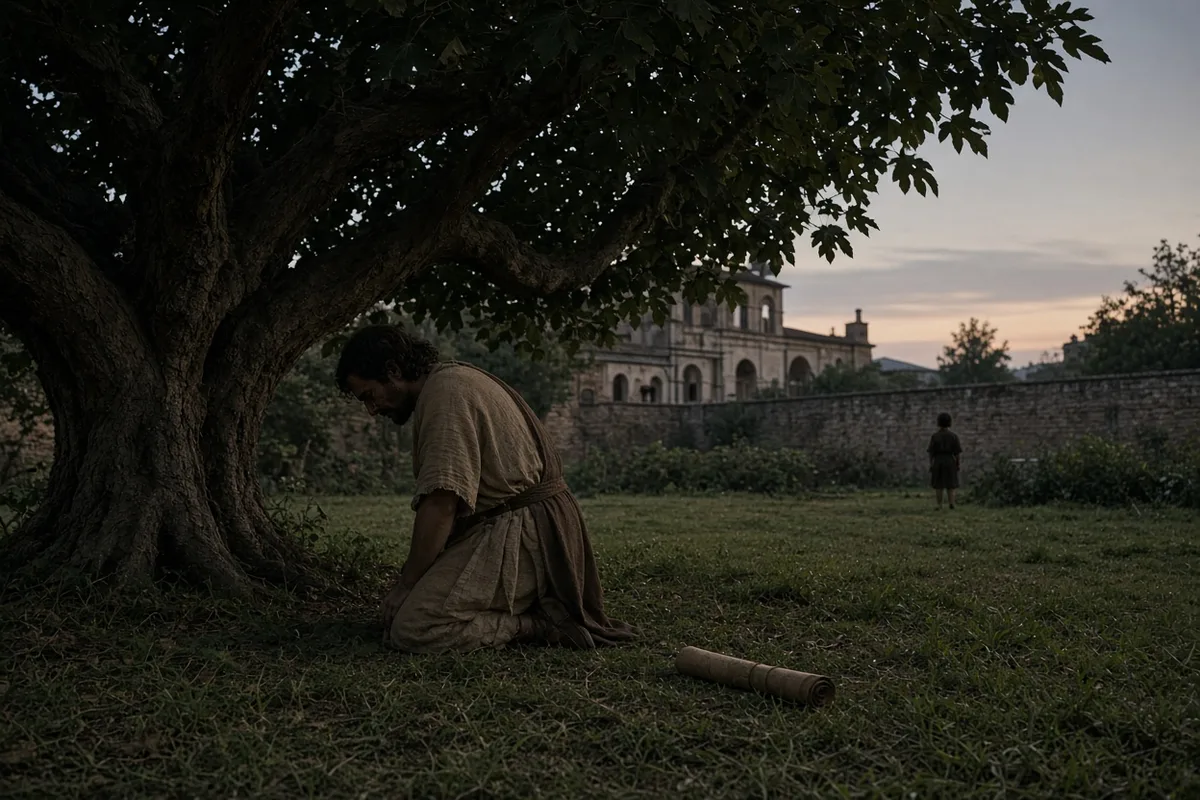
I did not follow him in. It was not my place, and besides, something in the way he walked told me to keep distance. He went out among the trees alone, and for a long while there was nothing from that part of the garden but stillness, and then the weeping began, low at first and then breaking loose entirely, the sound of a man finally letting something go that he had held clenched for years. I heard him fling himself down under one of the fig trees near the far wall. I heard, faintly, words rising out of the weeping — asking how long, how long, tomorrow and tomorrow again, why not now, why should this hour not be the end of it.

And then, over the wall, from the courtyard of the house next door, came a child's voice, sing-song and careless, the kind of chant children invent for a game and repeat without knowing why it pleases them. Take it and read it, the voice went, take it and read it, over and over, light as nothing. I heard it too, from where I stood, and thought only that it was a strange little rhyme for a child to be singing. I did not know yet what it would do to the man crying under the fig tree twenty paces away.
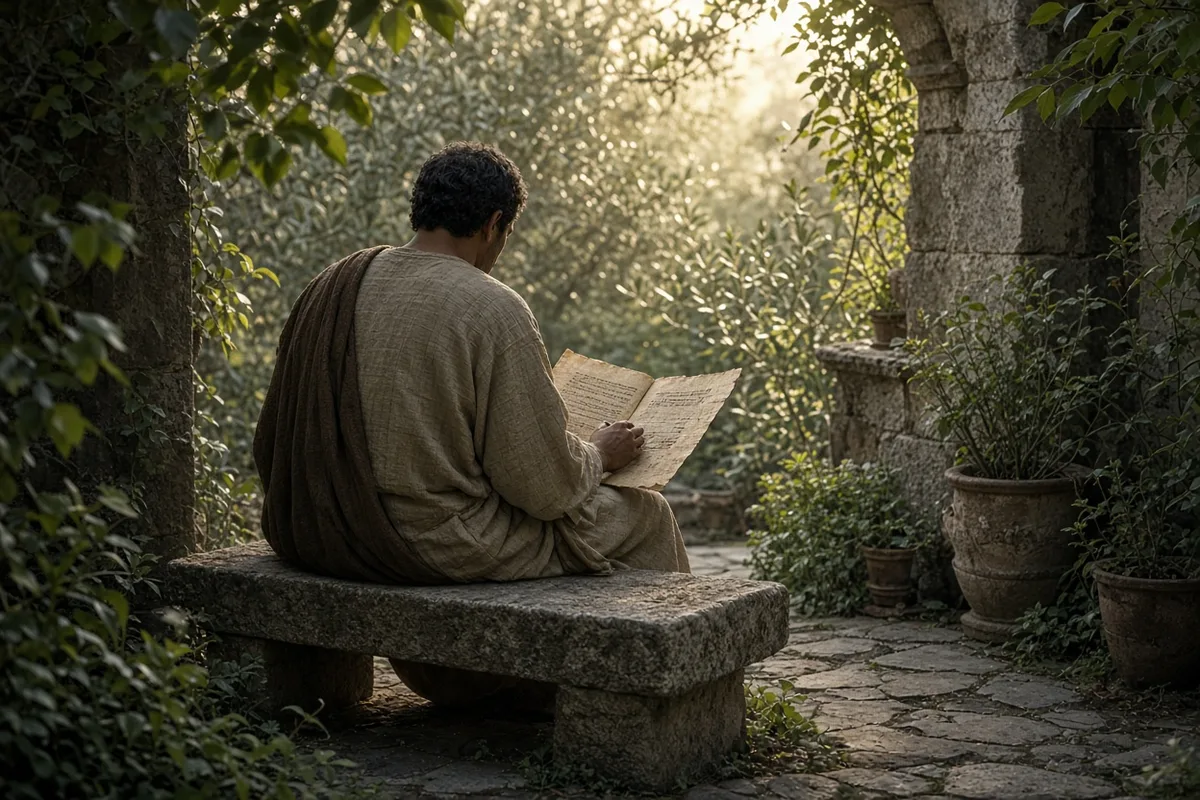
The garden went silent so suddenly that I noticed the change before I understood it. No more weeping. I heard footsteps instead, quick, deliberate, a man rising and walking with purpose after sitting broken for so long. He was turning the chant over in his mind the way he turned over any text set in front of him, asking himself whether he had ever heard of children singing such a thing in any game he knew, and finding no answer, deciding there was none — deciding, instead, that it had been sent to him, a command spoken in a child's mouth that he was meant to obey exactly as it was said. Take it and read it. There was a book near where he had been sitting, a copy of Paul's letters left on a bench, and I heard him snatch it up.
What happened next he told many times afterward, and told it the same way each time, so that even those of us who only heard the garden from a distance came to know the shape of it by heart. He opened the book without choosing where, let his eyes fall on whatever page came first, and read in silence the lines in front of him — words about behaving honestly, not in orgies and drunkenness, not in immorality and jealousy and strife, but putting on the Lord Jesus Christ instead and making no more room for the old appetites to be fed. He read no further. He said afterward that he needed no more, that the moment the sentence ended something like light broke into him, and every doubt that had darkened him for years simply went out, the way a room goes quiet when a storm outside has finally passed.
I saw him come out from among the trees not long after, and his face was not the face that had gone in. Whatever had been clenched in it was open now. He went straight to find his mother, and I was near enough to see Monica's expression when he told her — not surprise, I thought, so much as relief long delayed, the look of a woman whose water had finally, after all those years, worn through the stone she'd been kneeling against.
He did not rush to be baptized that same season. There was time given to quiet and to study first, the kind of retreat a man takes when he has just discovered that the ground under him has changed and he wants to learn to walk on it properly before he shows anyone else his steps. It was not until the following spring, on the eve of Easter in 387, that Ambrose brought him down into the water himself and baptized him, with Monica standing by to see it, her long errand finally answered in full.
Word of what happened after that reached us the way news reaches a household after a guest has gone on to his own life — in pieces, months apart, carried by travelers and letters. He returned toward Africa, toward the town of his birth, and might well have stayed content there living a quiet life of study among a small community of men given to prayer and reading, the kind of retreat many a converted rhetorician might have chosen and been forgotten by history for choosing. But his reputation had outrun him. While visiting the coastal town of Hippo Regius, the people there recognized who had come among them, and rather than let him slip quietly back to his retreat, they seized him and brought him before the bishop to be made a priest on the spot. He asked, by what I heard, for time to deepen his grasp of Scripture before taking on such a charge, and was given it. He was ordained in 391, and within four years he was consecrated bishop of that same town, a position he would hold for the rest of his life.
From there the reports of him only grew louder. He was drawn into every dispute the church of that age produced, and stood at the center of the largest of them. Against the Donatists, who would not accept clergy who had once given up the Scriptures under persecution or anyone ordained by such a man, he argued that the church could not be split into rival bodies of the pure and the impure, that the sacraments worked by the grace of God moving through them and not by the private holiness of whichever priest happened to administer them — a sacrament, he wrote, was a visible sign of an invisible grace, a phrase that outlived the argument it was coined to settle. In time his position carried the day, and the Donatist movement that had once numbered in the thousands around him lost its force. Against the teaching of a man called Pelagius he fought as fiercely again, defending the conviction, hard-won in his own life, that grace was not something a man could earn by his own unaided effort but something given, the way a chant sung by a careless child had once been given to a weeping man under a fig tree who had done nothing to deserve it.
He wrote across the rest of his years in a volume that is difficult to hold in the mind all at once — by the reckoning of those who later counted such things, something past five million words, letters and sermons and treatises that would shape how the church thought about sin and grace and the nature of God for more than a thousand years afterward. Of all he wrote, though, it was the story of that one afternoon in the garden that traveled furthest and lasted longest, told and retold long after the man himself, and the mother who prayed him into that garden, and the servant who happened to be drawing water within earshot of it, were all three long past speaking of it themselves.
I think sometimes of that child's voice, whoever it belonged to, singing a rhyme it most likely forgot by suppertime. It never knew what it had started on the other side of that garden wall. Somewhere in Milan a boy or a girl went home that evening to an ordinary meal, while twenty paces away a man who would go on to write more words than any Christian before him had picked up a book because of them, and did not put it down the same person who had lifted it.