The Damascus Road
A dramatized first-person retelling of documented events
I carried the satchel with the letters in it, the ones sealed by the high priest himself, and I remember thinking how light they were for what they meant. Parchment and wax, nothing more, but enough to drag men and women out of their houses in Damascus and bind them for the journey back to Jerusalem. I was one of the party assigned to Saul of Tarsus for that errand, one of several who walked beside the mules and watched the road for bandits, and I did not think much about the weight of what we were doing. We were doing the will of the council. That was enough for me then.
Saul did not travel like a man doing a chore. He travelled like a man on fire. I had seen him in the city before we left, moving from house to house with the zeal of someone who believed every follower of the Nazarene was a splinter working its way toward the heart of Israel, and he meant to dig out every one of them. He spoke of the Way as a disease. He used the word rage without embarrassment. I had heard him breathe threats against them the way another man might breathe threats against a debtor who owed him money, except Saul owed them nothing and hated them anyway, purely, for what they believed.

The road from Jerusalem to Damascus is not short. Six days, seven if the weather turns, north through the hill country and down along routes worn smooth by centuries of traders and pilgrims and soldiers before us. We left in the cool of early morning so the mules would not suffer, and by midday the sun over that country has no mercy in it at all. I remember the dust most of all, fine as flour, rising with every hoofbeat, settling into the creases of our clothes and the folds of our eyelids. Saul rode ahead of most of us, or walked ahead, depending on the terrain, always a pace faster than the pace we kept.
We talked, on that road, the way men talk when there is nothing else to do but walk. Someone mentioned the stories, the ones about the Nazarene's followers claiming he had risen, claiming they had seen him. Saul did not laugh at these stories. He answered them the way a man answers an insult, sharply, with his jaw set. I understood, even then, that his hatred of the Way was not cold calculation. It was personal. It came from somewhere I could not see into, some place where his whole understanding of God and the Law and what pleased God sat close together, tight as bricks in a wall, and any crack in that wall felt to him like a crack in the world itself.
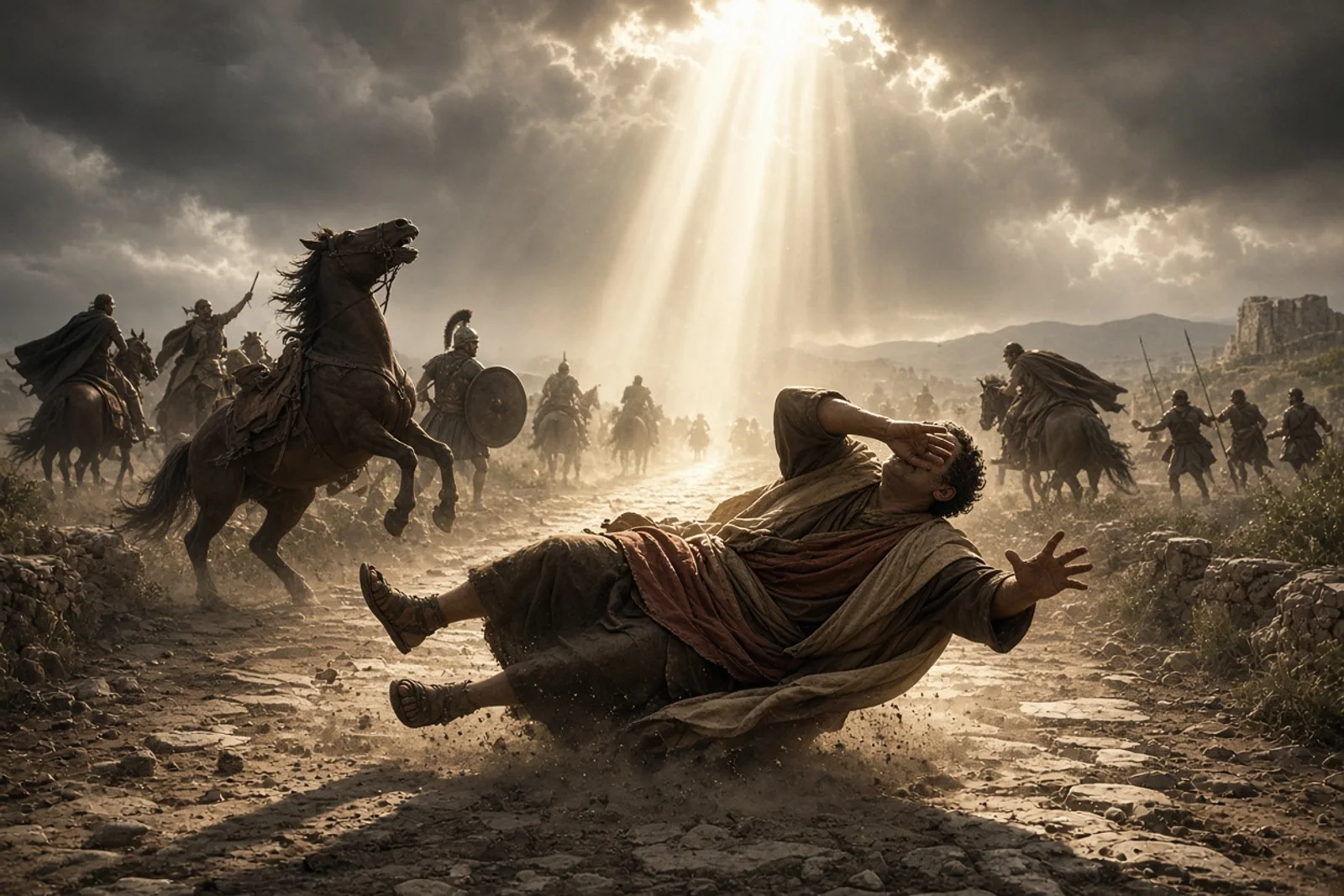
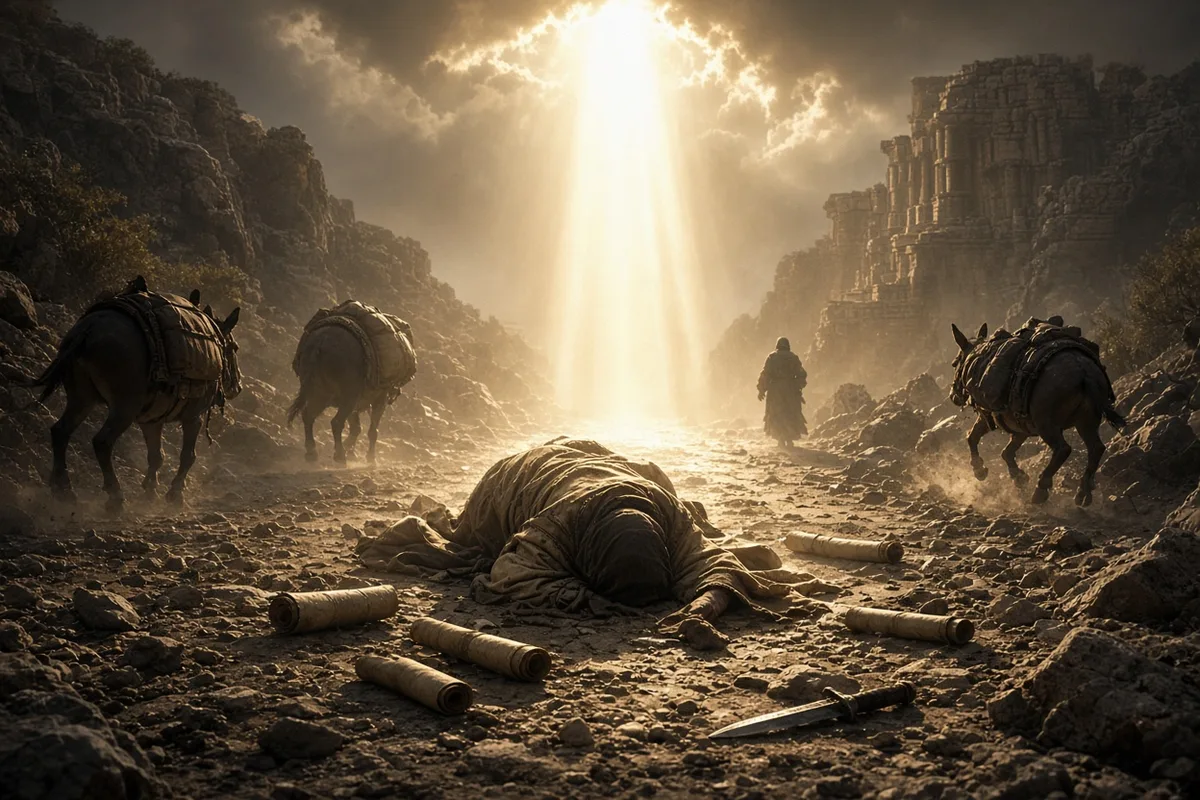
By the time we came within sight of Damascus, the walls pale in the distance, the orchards outside the gates green against all that brown hill country, it was near midday again. I remember that because I remember the light. Not the ordinary brightness of noon, which I had felt on my neck and shoulders every day of that journey, but something else entirely, something that came down on us all at once like a curtain dropped from a great height.

I went down. I did not choose to go down. My knees simply were not there anymore, and the ground came up to meet my face, and around me I heard the others falling too, the whole party, men and mules stumbling and crying out, and for a moment I thought we had been struck by something out of the sky, a fire from heaven the way the old stories tell of fire falling on wicked cities. I could not see anything but light. I could not hear anything clearly either, except a sound, a voice, though I could not have told you a single word of it. It was not meant for me. I understood that even in my terror. Whatever was being said, it had one destination, and that destination was lying a few feet from me in the road, and he was the only one of us who seemed to understand what the sound was saying.
I heard him answer. I heard him say the word Lord, and I remember that more than anything else from that whole day, because Saul did not use that word carelessly, and he did not use it for anyone he considered beneath the God of Israel. Something in his voice had already broken by the time he said it. Whatever he saw in that light, whatever he heard in that voice, he already knew before he asked his question that the answer was going to undo him.
Then came the second thing he said, "who are you, Lord," and then a silence in which none of us breathed, and then the answer came, and though I did not hear the words plainly, I saw what they did to him. His whole body went rigid, and then loose, like a man who has just learned his house has burned down with his family inside it. I had never seen anyone look like that. Not fear exactly. Something under fear. The face of a man discovering that everything he had built his life on for forty years had been standing on air.

I do not know how long we lay there. Time does strange things when the sky opens. When the light finally lifted, when I could blink and see the ordinary world again, the dust, the mules shifting their feet nervously, the orchard trees still green and unbothered by any of it, I looked over and saw Saul getting up slowly, one hand out in front of him, patting at the air the way a blind man does when he is trying to remember the shape of a room he can no longer see.
He was blind. Truly blind, not from the brightness the way your eyes ache after staring at the sun too long, but blind in a deeper way, a way that did not fade as the minutes passed. He asked for a hand, and no one moved for a moment, because none of us knew what to do with a man like that, a man who a breath before had held all the authority of the high priest in his voice and now stood swaying in the road like an old beggar. I was the one who finally stepped forward and took his arm.
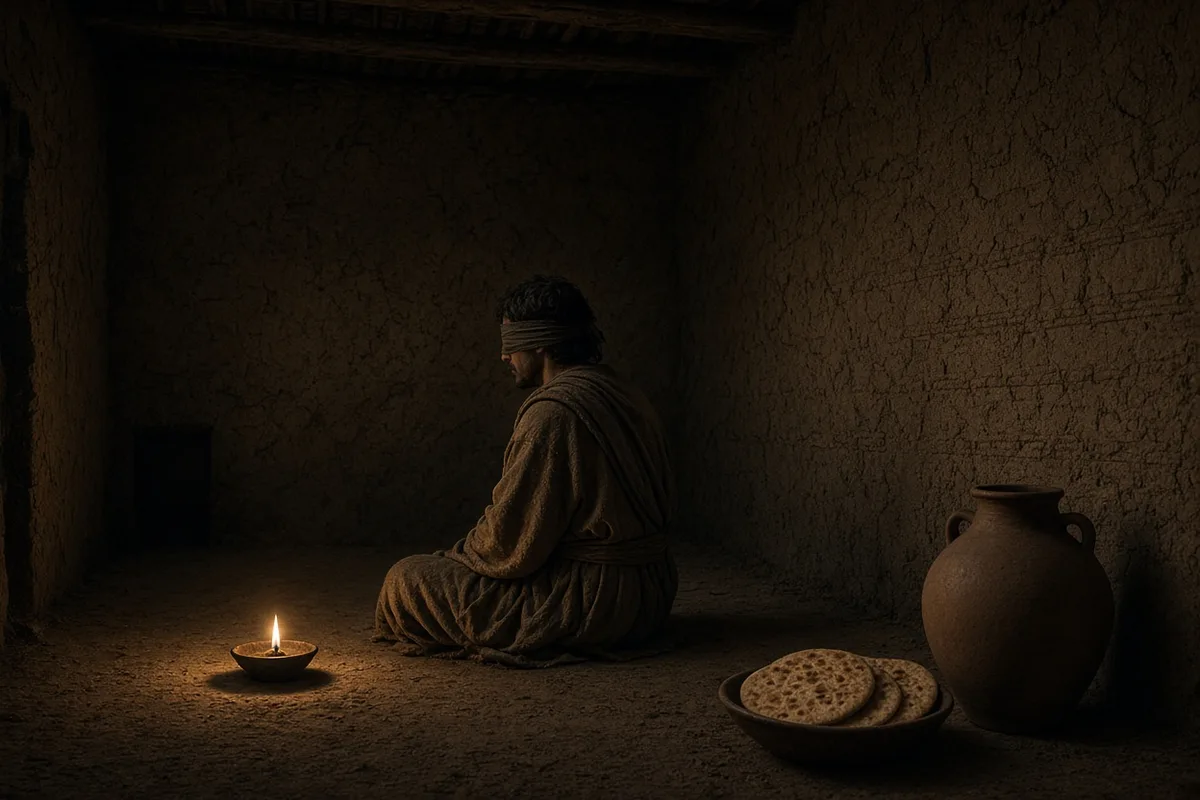
He did not eat. He did not drink. Not that day, not the next, not the one after. We got him into Damascus somehow, walking him slow through the gate with his hand gripping my forearm hard enough to leave marks, and I remember the strange quiet of him after that first terror passed, how he did not rage anymore, how the fire that had driven him the whole six days out of Jerusalem seemed to have gone out entirely and left something colder and stranger in its place. He asked questions in a low voice. He asked what he had done. He did not ask like a man defending himself. He asked like a man trying to understand how he had been so wrong about something for so long without ever once suspecting it.
Three days he sat like that in the house where we left him, sightless, refusing food, and I do not think anyone who saw him then would have believed he was the same man who had walked out of Jerusalem carrying the high priest's authority against the followers of the Nazarene. The zeal was still there, I think, buried somewhere under the silence, but it no longer had anywhere to go. He simply waited. For what, none of us knew. He would not have known himself, except that the voice on the road had told him to go into the city and he would be told what to do, and so that was what he did. He waited to be told.
There was a man in that city, a follower of the Way himself, named Ananias, and word came that he had received some vision of his own, telling him to go to the house where Saul was staying and lay hands on him. I heard afterward, though I did not hear it from Ananias's own mouth at the time, that he did not want to go. Everyone in Damascus who followed the Way knew the name Saul of Tarsus, knew what he had done in Jerusalem and what he had come to Damascus to do, and no one in his right mind walks willingly into a room with the man carrying the letters meant to arrest him. But Ananias went anyway.
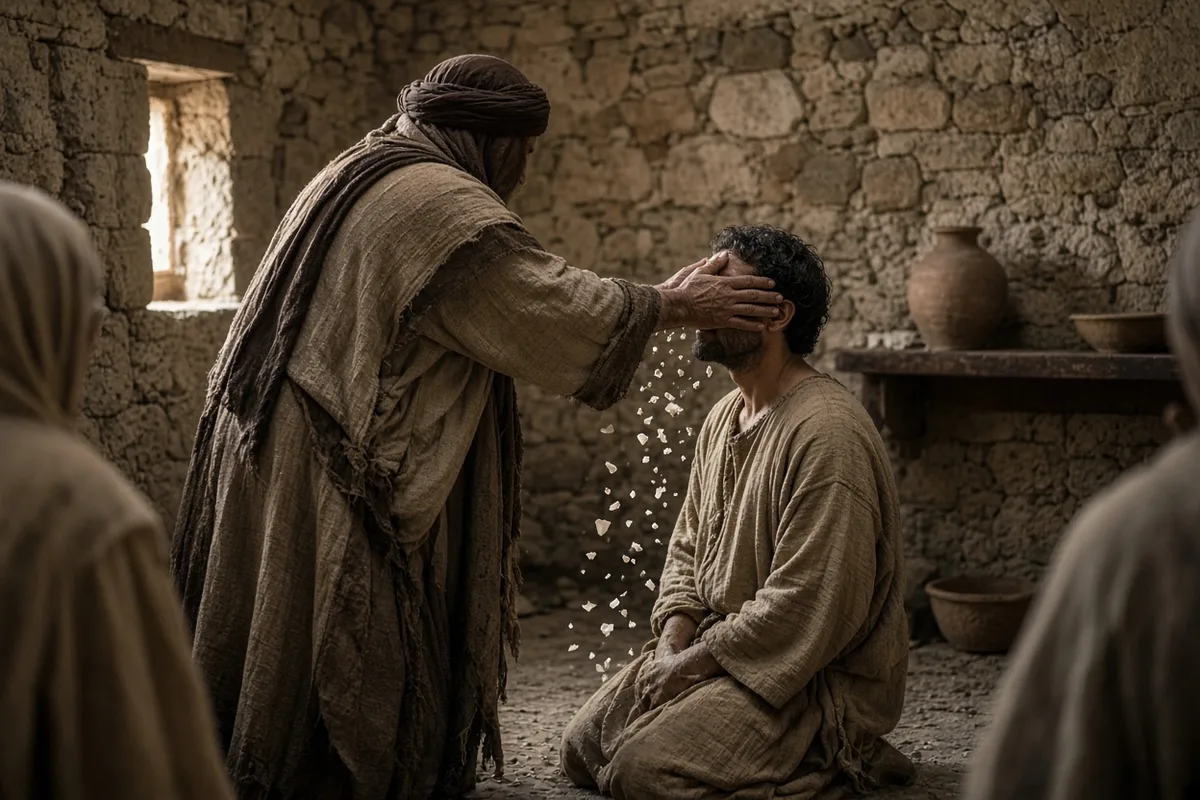
I was near the doorway when he came in, and I watched him cross the room to where Saul sat with his sightless eyes turned toward nothing in particular, and Ananias put his hands on him gently, the way you might touch a man you were not sure would strike out at you. He spoke to him kindly. He called him brother. I do not think I had ever heard anyone in that city call Saul of Tarsus brother, not with affection, not without fear behind the word.
Something like scales, they said afterward, fell from his eyes. I saw the change happen, though I could not have told you the mechanism of it even if you had asked me that same hour. One moment his face was turned blank toward the wall, and the next his eyes were moving, finding Ananias, finding the room, finding the light coming through the window as though he had never seen ordinary daylight before in his life and needed to relearn what it meant. He wept. I remember that plainly, because I had never once, in all the days I had walked beside him from Jerusalem, seen anything in him that looked like tears.
He ate after that. He drank. And within days, the man who had come to Damascus to drag believers out of their houses in chains was standing in those same houses, speaking of the Nazarene as the Son of God, with the same fierce conviction he had once used to condemn anyone who said such a thing. I watched the faces of the people who listened to him. Astonishment does not cover it fully. Some of them looked at him the way you look at a man risen from a fever you thought would kill him, grateful and wary at once, unsure whether to trust that the change would hold.
He was baptized in that city. I did not stay to see everything that followed, the years of it, the arguments in synagogues, the disputes even among the believers themselves who could not quite believe the persecutor had become one of their own, the plots against his life that sent him over the wall of Damascus in a basket not long after, but I heard, as most in that part of the world eventually heard, what became of him. He took the name Paul, and he went where none of his own people had ever thought to send a message, out among the Gentiles, into cities I never saw, across seas I never crossed, carrying the very thing he had once sworn to destroy.
I think of him sometimes still lying in that road, his hand out, patting the dust for something to hold onto. That image has stayed with me longer than any sermon I ever heard him give or heard reported of him. A man utterly certain of his righteousness, brought down in an instant, blind in the brightest hour of the day, asking a voice he could not yet name what it wanted of him. I do not know what I expected persecution's end to look like, if I expected it to end at all, but I did not expect it to look like a man groping in the dirt outside a city he had come to burn clean of believers, three days without bread, waiting to be told who he was now.
The letters never got delivered the way the high priest intended. I still had them in my satchel when we finally left that house, the wax seals unbroken, useless now, artifacts of an errand that had ended before it began. I do not know what became of them in the end. I know what became of the man they were meant to serve. He walked out of Damascus a different animal altogether than the one who had walked in, and wherever the road took him after that, it was never again the road to arrest anyone for believing what he himself now believed with his whole ruined and remade heart.
Comments
Free account · your comment posts right after signup