Pascal's Night of Fire

A dramatized first-person retelling of documented events
I banked the fire in his grate that evening the way I did every evening, raking the coals close so they would hold through the small hours, and I remember thinking that the room felt colder than the fire could account for. Monsieur Pascal had been quiet at supper. He ate almost nothing. This was not unusual for him — his stomach had given him trouble for years, since he was a young man, and there were whole weeks when I carried more food out of his chamber than I ever saw him swallow — but that night the quiet had a different weight to it, the kind that makes a servant walk more softly without knowing why.
By then everyone in the house knew who he was, or thought they did. A mathematician talked about since he was a boy of sixteen. A man who had built a machine that could add sums faster than a clerk, who had argued with the great minds of Paris about vacuums and pressure and the weight of air itself, who kept company with dukes and gamblers alike because his mind was worth more to them than his rank. The Chevalier de Méré and men of his circle came round often enough in those years, full of wine and wagers, and Monsieur Pascal could hold his own with them at cards and at reasoning both. He had a restlessness in him. I saw it in the way he paced his study, in the way he burned candles down to nubs over papers that made no sense to me, geometry and numbers crowded into margins like ants.

His father had been dead three years by then, and I think the house never quite settled after that loss. Monsieur Étienne had raised his children hard on learning and harder on faith, and of the two children left in Paris and the one gone to the convent, it was the sister, Mademoiselle Jacqueline, who had taken the faith and run furthest with it, all the way to Port-Royal, where she had given up her name for a nun's habit. She wrote to her brother. I carried some of those letters up the stairs myself, sealed and heavy with whatever conscience she meant to press into him. He read them alone, always alone, and afterward he would sit very still for a long while, the letter in his lap, looking at nothing.
That Monday was the twenty-third of November, the feast of Saint Clement, pope and martyr — I knew it because the cook kept the almanac by the kitchen fire and read the saints aloud most mornings, more from habit than piety, and I remember her saying it was also near the day of Saint Chrysogonus, a name none of us could pronounce without stumbling. It meant nothing to me at the time beyond marking the date on a page. I had no reason to fix it in memory. I only did, later, because he fixed it first, and more precisely than I ever could have — down to the half hour, as if a clock had been standing in the room with him the whole time.

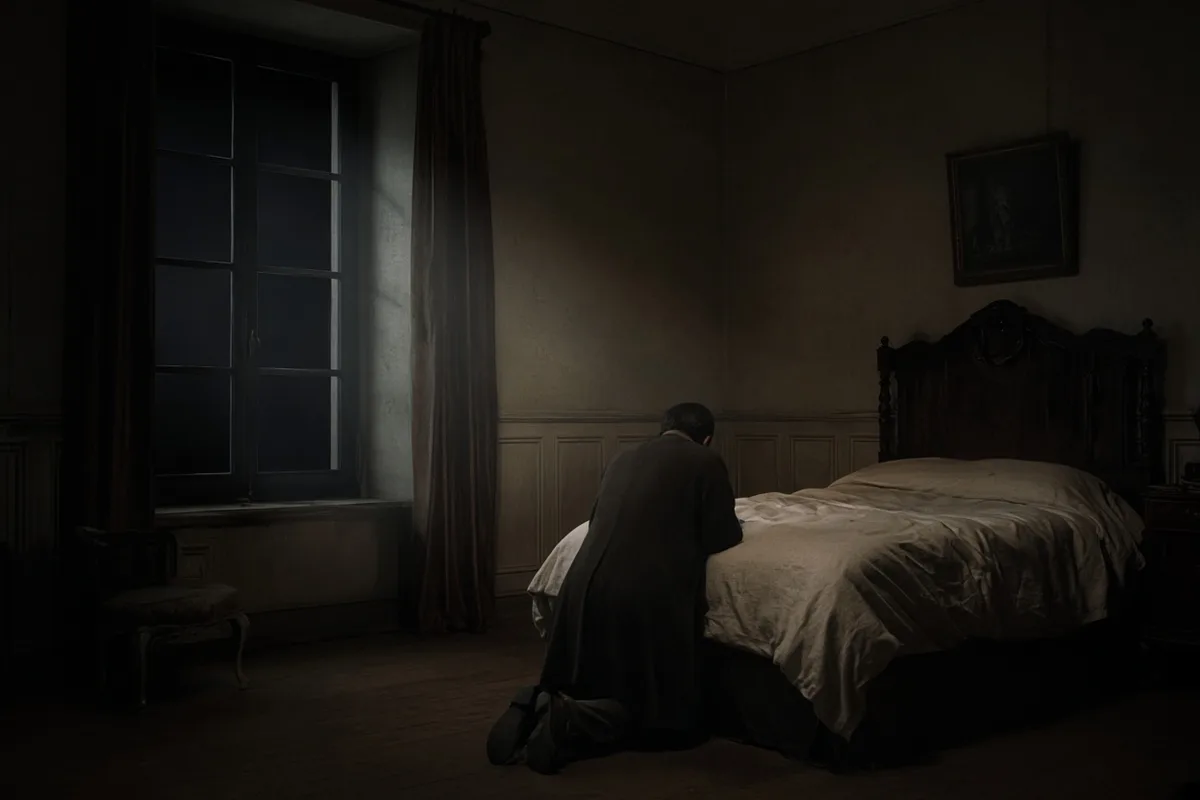
He went to his chamber earlier than his habit that night. I remember passing his door near ten and seeing the line of candlelight beneath it, steady, and thinking he meant to work as he often did until the small hours. I went to my own rest not long after. My room was near enough that I would sometimes hear him moving about above, the scrape of a chair, the creak of the floor where he liked to walk while he thought through a problem. That night I heard nothing so ordinary. I heard, once, what I took for a low voice, though I could not have told you if it was speech or weeping, and then a long stretch of silence that seemed to press on the whole house.
I did not go up. It was not my place, and there was, besides, something in the quality of that silence that kept me where I was, the way you do not open a door on a room you sense is full of something you were not asked to see. The candle stayed lit far past when it should have burned itself out, which meant either he had lit a fresh one or had not moved from wherever he sat. I lay awake longer than I meant to, listening to nothing, feeling the cold come up through the floorboards, and somewhere in that stretch of nothing the church bells must have struck half past ten, and later midnight, and later still the half hour past — though I could not swear, lying there, that I counted every stroke. He counted them. That much I would come to know.
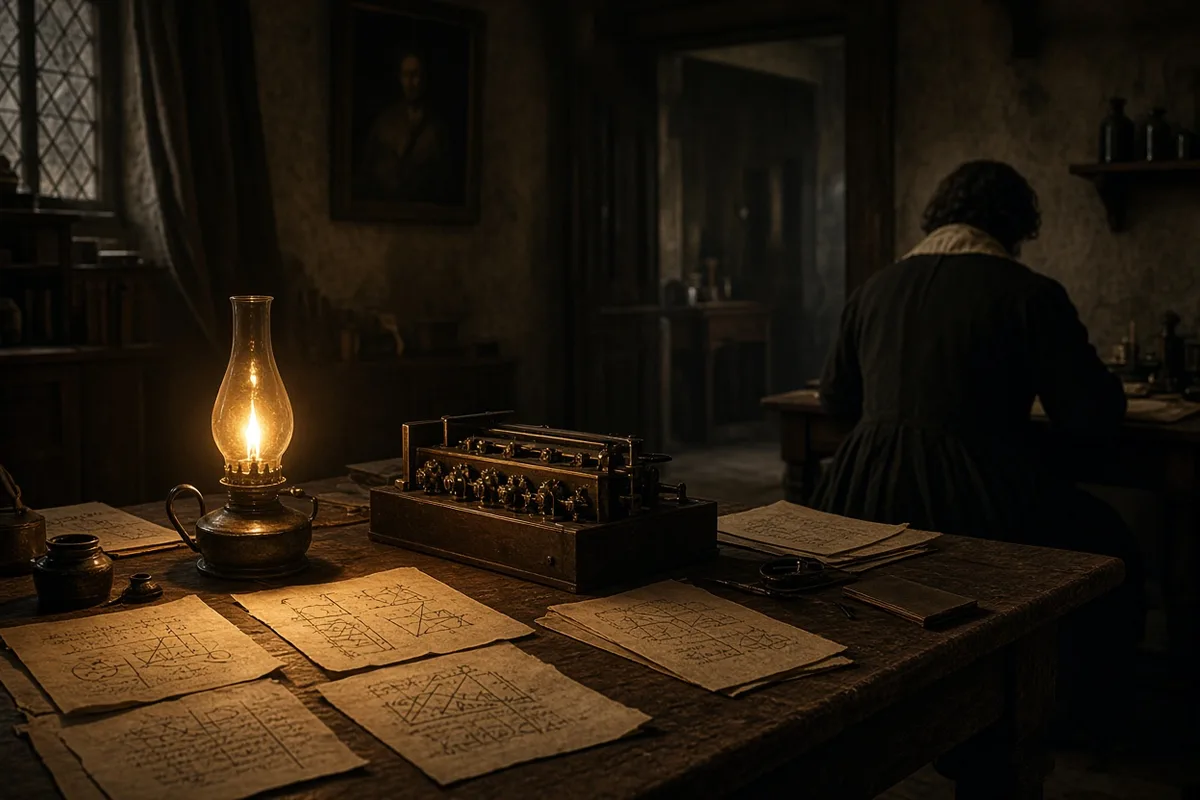
Whatever passed in that room passed without a witness but himself. I have turned it over many times since, the shape of those two hours, and I can tell you only what a servant in the house that night can honestly tell you: that a light burned where it should not have burned so long, that a silence fell where there should have been the ordinary sounds of a man readying for sleep, and that when I finally did sleep myself, whatever had been happening above me was still happening, sealed behind a door I did not open.
I saw him the next morning and did not know him. That is not right to say — I knew his face, his stoop, the same coat he had worn the day before — but something behind the face had changed in a way I have never been able to name cleanly. His eyes were red as a man's who has wept for hours, yet there was no heaviness in him, none of the dullness that follows grief. He moved through the morning almost lightly, like a man who has set down a great weight he had carried so long he no longer remembered its exact size. He said nothing to me of the night. I did not ask. But I noticed he asked for paper before he asked for food.
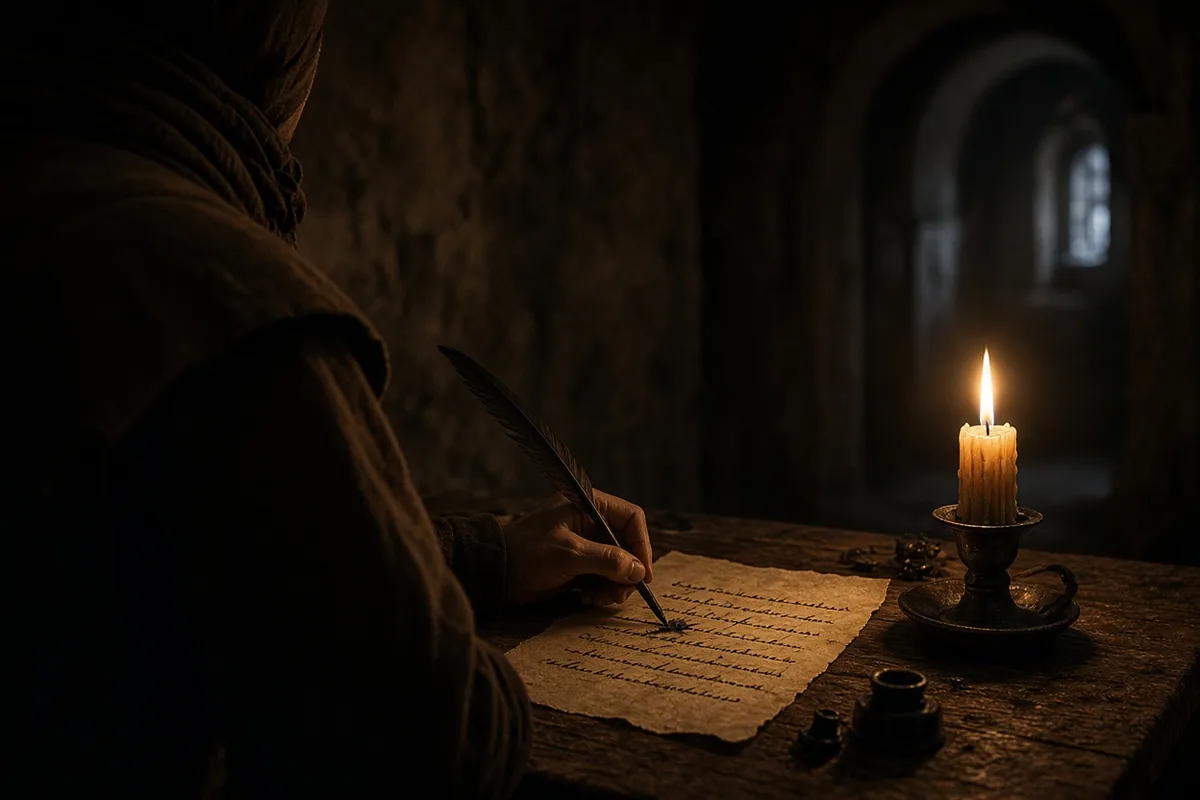
I saw him at his table later that same day, or perhaps the day following — the order of it has blurred with the years — bent low over a small sheet, writing fast, his hand cramped and hurried in a way I had never seen from a man usually so careful with his letters. He wrote as though the words might leave him before he could catch them. When he finished he did not blot it and set it aside the way he did his mathematics. He folded it small, smaller than seemed sensible for a sheet of paper, and put it inside his coat, near his breast, and sat very still.
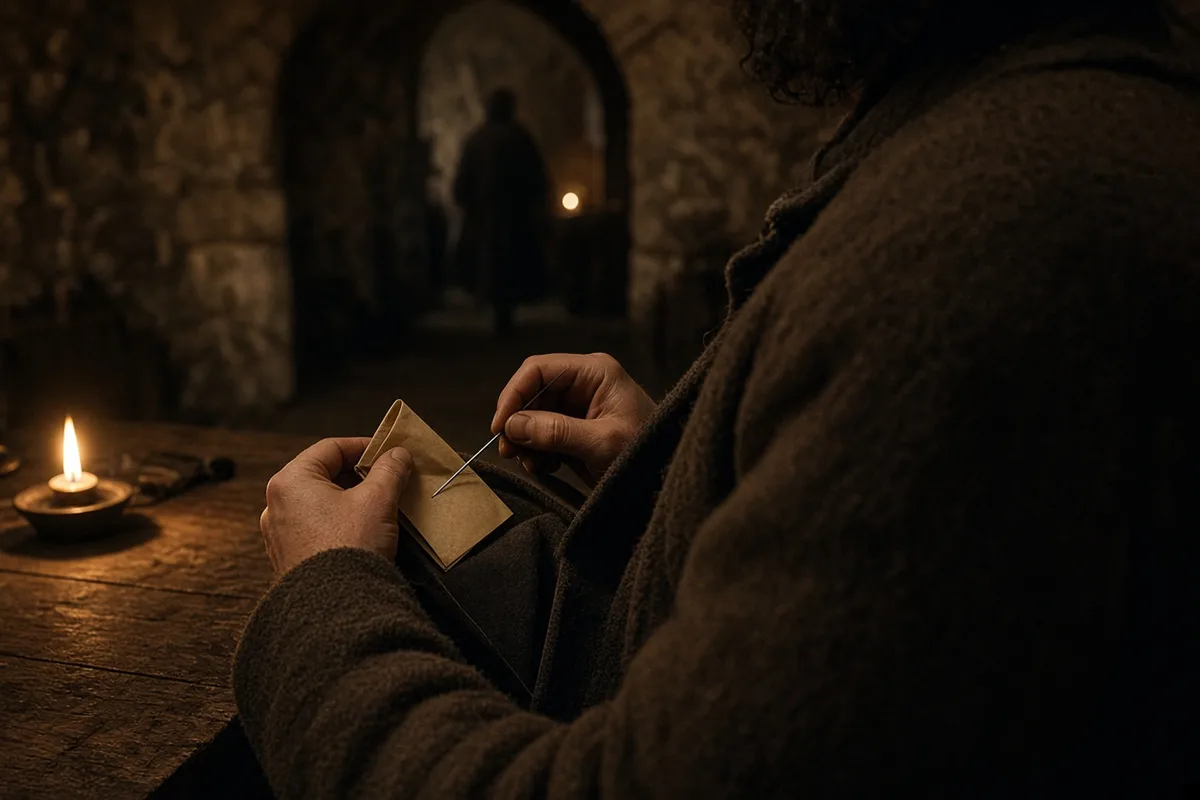
Weeks later I came upon him with a needle in his hand, which was strange enough in itself for a gentleman to be doing his own stitching, bent over the lining of that same coat, working a small seam closed with the same careful frowning attention he gave his equations. He did not explain what he was sewing in, and I did not ask, though I understood well enough that it was that folded paper, and that it was meant to stay hidden and close to his body rather than locked in any drawer where a servant's hand might find it by accident while brushing down his clothes. A man does not sew a thing into his own coat unless he means to carry it everywhere he goes, awake and asleep, for as long as the coat survives him.
And carry it he did. In the months that followed I watched him draw away from the company he had kept before — the gaming tables, the wagering men, the Chevalier de Méré's set who had once filled the house with their laughter and their talk of odds and probabilities. He did not renounce them with any scene or announcement. He simply stopped being where they were. He gave more of himself to Port-Royal, to the severe and quiet devotion his sister had already chosen, and though he never abandoned the sharpness of his mind — he was still scribbling, still arguing, still filling pages with thoughts he meant one day to gather into a defense of the faith he had not troubled himself much over before — the restlessness that had driven him from card table to laboratory to salon seemed, from where I stood with the washing basin and the swept floor, to have quieted into something with a single direction.
He wore that coat, or had its lining moved when the cloth itself wore through, for the rest of the years I served him. I noticed it the way a servant notices such small constant things — the particular weight of a garment when you lift it to brush it, a stiffness in the lining that should not be there. I never once unpicked the seam myself. Whatever pride or duty kept my hands off it, I cannot fully say. It was his. A man's coat is a small country, and I did not think it mine to cross that border uninvited.
His health, which had never been strong, wore down further as the years went on. The headaches that had plagued him since boyhood grew worse, and there were long spells when he could not work at all, when the light itself seemed to pain him and he kept to darkened rooms. Even so he did not part with the coat, or if the coat itself gave way to age, the lining and its secret passed with careful hands into whatever replaced it. It traveled with him from house to house, from one decline to the next, through the failing months when it became clear to everyone in his household that he would not recover his strength.
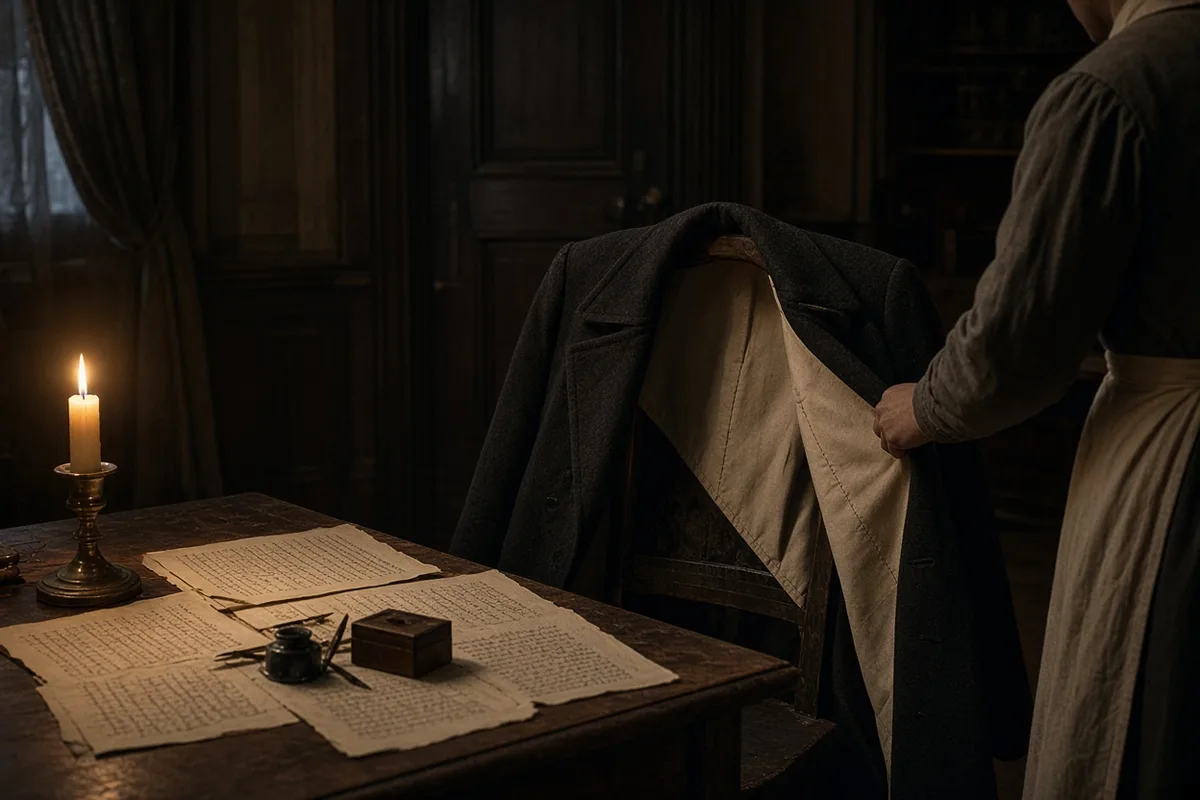
When he died, it fell to those closest to his body to see to the ordinary, sorrowful business of preparing him — the washing, the dressing, the folding away of a life's clothing. It was in going through that clothing that someone's fingers found what mine never had, a stiffness in the lining too deliberate to be an accident of tailoring, and undid the stitches he himself had sewn so many years before. Out came a small folded paper, worn soft at its creases from having been carried against a man's chest through every day and night since that November.
I was in the house when it was found, though not the one whose hands did the unpicking, and I remember the stillness that came over the room when the paper was opened and someone began, haltingly, to read what was written there. It began with the date, set down with the same exactness a mathematician gives to a proof — the year, the day, the feast, the vigil, the hours, half past ten until half past midnight — and then a single word standing alone on its own line, as if nothing else could follow it properly. FIRE. And beneath it, broken phrases, none of them finished sentences in the way a letter or a treatise would demand, as though he had been trying to set down not an argument but the aftershock of one: certitude, certitude, feeling, joy, peace; the God of Abraham, of Isaac, of Jacob, not of the philosophers and the learned; joy, joy, joy, tears of joy.
There were harder lines further down, of having fled, of having denied, of having been separated from what he had once touched and dreaded losing again, and a line near the close about total and sweet renunciation, submission entire to Christ and to the man who had guided his conscience, as if the fire he had felt that night demanded not only to be believed but to be obeyed for the rest of a life. It ended with a plea not to forget the words at all, and the single word that closes such things. Amen.
No one in that room that day claimed to understand fully what he had seen or felt in those two hours behind his shut door eight years before. I certainly did not, and do not now, though I was near enough to it on the night itself to have heard the silence it left in its wake, and near enough to its ending to have seen a man's face changed by morning into something calmer than grief and steadier than relief. We only had the paper, and the coat it had ridden in through every ordinary day since, brushed and folded and carried by hands like mine without ever once knowing what it held against his heart.
The coat itself did not survive, as coats do not. But the paper did, passed from hand to hand among those who had loved him, copied out, argued over, kept. I think of it still — how a man so sure of numbers, so exacting about proofs that other men could spend a lifetime failing to disprove, could find no better vessel for the two most overwhelming hours of his life than a scrap of paper folded small and stitched, in his own uneven hand, into the one garment he wore closest to his skin.
Comments
Free account · your comment posts right after signup