Mendel Discovers Genetics in the Monastery Garden
A dramatized first-person retelling of documented events
The frost was still on the trellis wire when Brother Mendel bent down and counted the same row for the third time that morning, and I knew better by then than to ask him why. Ten years old rows planted, ten thousand pods counted before, and still he checked his own numbers as if the peas might have lied to him overnight. I held the ledger open against my forearm so the wind wouldn't take the pages, and I watched his lips move without sound, tallying green against yellow, smooth against wrinkled, the whole business as quiet and as serious as a man saying his rosary.
I had come to the Abbey of St. Thomas as a boy who could dig a straight furrow and little else, hired to help keep the garden behind the monastery walls in Brno. Nobody told me at first why one particular friar spent more hours among the pea trellises than in the chapel choir. Later I understood that Abbot Cyrill Napp himself had asked it of him — that the two men shared a fascination with how living things pass their likeness down, father to son, blossom to blossom, and that the abbot had all but ordered the garden turned into a kind of church of counting.

Brother Mendel had not always seemed suited for much of anything, they said. He had trained for the parish, gone through the motions expected of a young priest, and failed at it plainly enough that his own mentor, Abbot Napp, wrote of an unconquerable timidity in him, a man not fit to stand before a sickbed or a coffin and find the right words. But he had grown up on his family's farm before the monastery ever took him in, and he had gone to Vienna to study science and mathematics, and somewhere in that unlikely combination — a farmer's hands and a mathematician's patience — the abbot saw exactly what the garden needed.
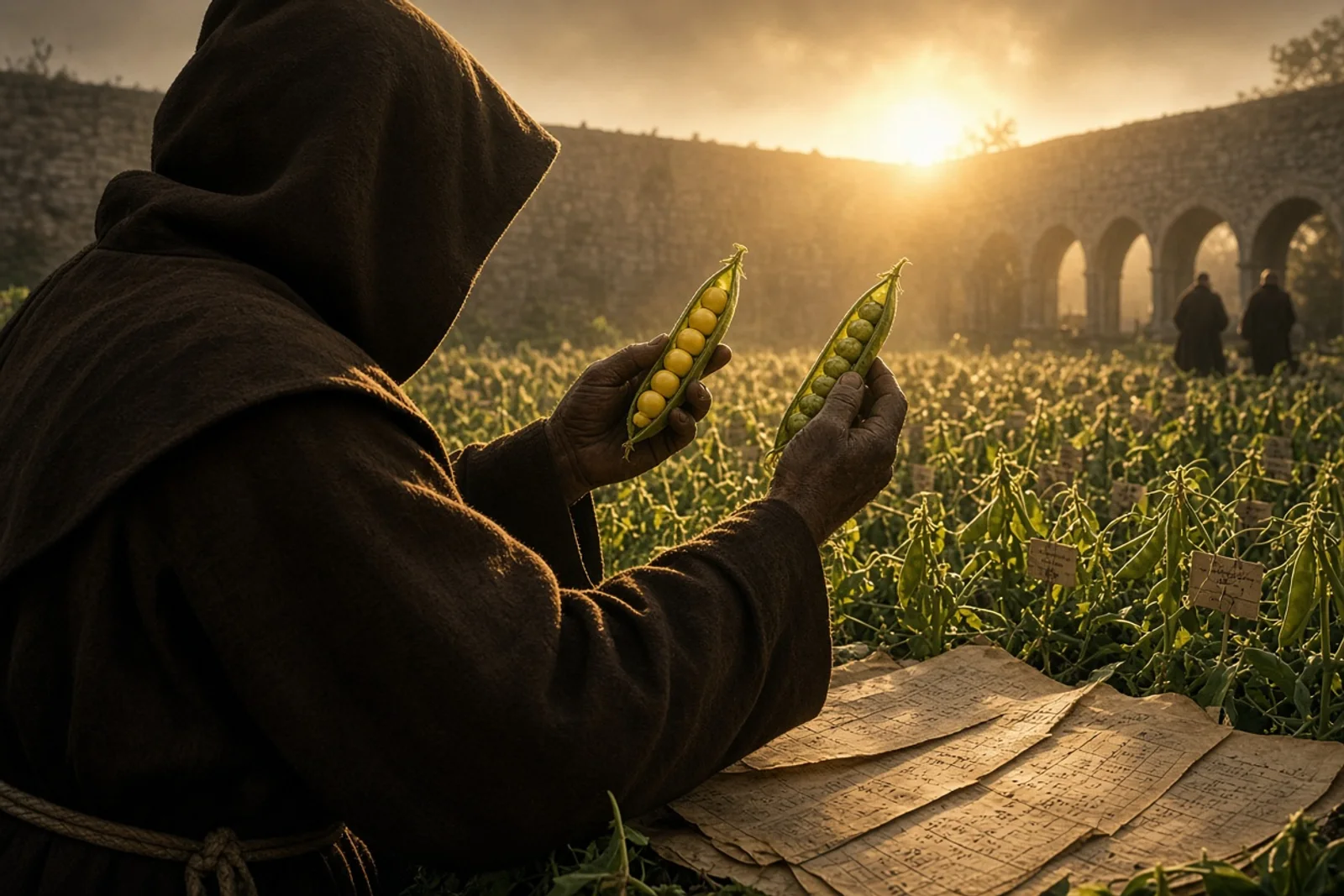
So it began in 1856, the year I first carried seed packets out to the beds behind the abbey wall. Row after row of Pisum sativum, the common garden pea, chosen not for beauty but for practicality. He explained it to me once, leaning on his hoe, that a pea plant would give you dozens of pods and hundreds of seeds from a single planting, and that its flowers kept mostly to themselves, self-pollinating inside their own petals unless a man took a fine brush and moved the pollen himself. That mattered to him more than anything. He did not want the wind or the bees deciding his results. He wanted to be the only hand in the whole transaction.

By the second summer I had learned to see what he saw — not vegetables, but variables. He had settled on seven characteristics to track, and he made me learn them the way I might have learned catechism: the shape of the seed, round or wrinkled; the color of the seed's flesh inside, yellow or green; the color of the seed coat; the shape of the pod; the color of the unripe pod; whether the flowers grew at the tip of the stem or along its length; and the height the plant would reach, tall or short. Seven small facts, and around them he built a labor that would run to nearly thirty thousand individual plants before it was through.
I remember the tedium most of all, because tedium was the whole method. Every plant tagged. Every cross recorded by hand, in a hand that never seemed to hurry. When he crossed a tall plant with a short one, he did not guess at what might happen. He waited, and he counted, and when the offspring came in overwhelmingly tall, he did not call it settled. He let those tall hybrids self-pollinate for another generation, and then another, watching for the short trait to vanish outright or merely go into hiding.
It went into hiding. That was the discovery inside the discovery — the short stems did not disappear from the bloodline, they simply waited, folded away somewhere unseen, and came back out in the next generation in numbers that repeated themselves too cleanly to be an accident. Three plants tall to every one short, again and again, bed after bed, year after year, and I watched him write those ratios down with the flat calm of a man confirming something he had already suspected in his bones.

He gave the traits letters instead of names, the way you'd give a soldier a number instead of a face. A capital letter for what showed itself, a small letter for what hid — Aa, Bb, Cc, tidy little pairs standing in for round seeds and wrinkled ones, yellow pods and green ones. I did not understand at the time that he was inventing a language that would outlive every man in that garden. To me it looked like a monk keeping very strange accounts.
Not everyone thought the accounts were worth keeping. I carried word once, from the abbey offices to the garden gate, of a letter Abbot Napp had written to Brother Mendel, and though I was not meant to read it, the page sat open on the potting bench long enough for me to catch the shape of it. The bishop had laughed, apparently, right in front of people, at the idea of a man of Mendel's education spending his days prying into what Napp's letter called the germinal proclivities of peas, when he might have been occupied with the writings of the Church Fathers instead. Napp wrote that he could not afford to have the monastery become the joke of the diocese. I looked up from the page and out at Brother Mendel, forty yards off, adjusting a paper tag on a pea vine with the unhurried attention of a man handling something sacred, and I thought: let them laugh from the diocese offices. He is not going to stop.
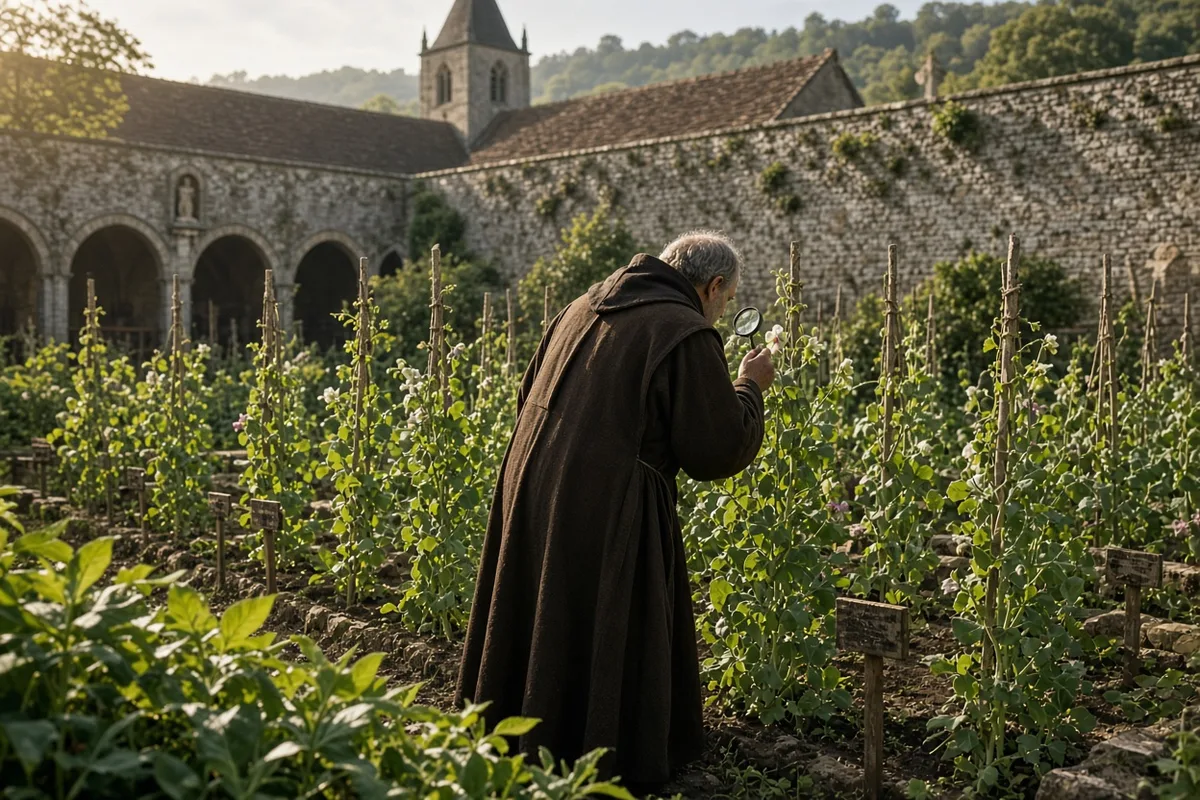
He did not stop. Through 1859, through 1860, through winters when the beds lay bare and he worked instead from the tallies already gathered, cross-checking column against column by lamplight in his cell. I was let go from garden work some seasons and brought back for others, but the rows themselves never rested for long, and by the time the count came due, in 1863, we had put something near twenty-eight thousand plants through his hands, one careful cross at a time.
What he had built, by the end of it, ran against nearly everything educated men believed about how a living thing inherits its shape. The common wisdom held that offspring blended their parents together the way you'd stir cream into coffee — a tall father and a short mother producing something in between, forever and evenly diluted, generation folding into generation until all traits ran to a kind of gray middle. Brother Mendel's numbers said otherwise. His peas did not blend. They chose. A trait was either fully present or it was tucked away whole, waiting its turn, and which one won out in a given plant could be predicted, almost to the pod, by simple arithmetic.
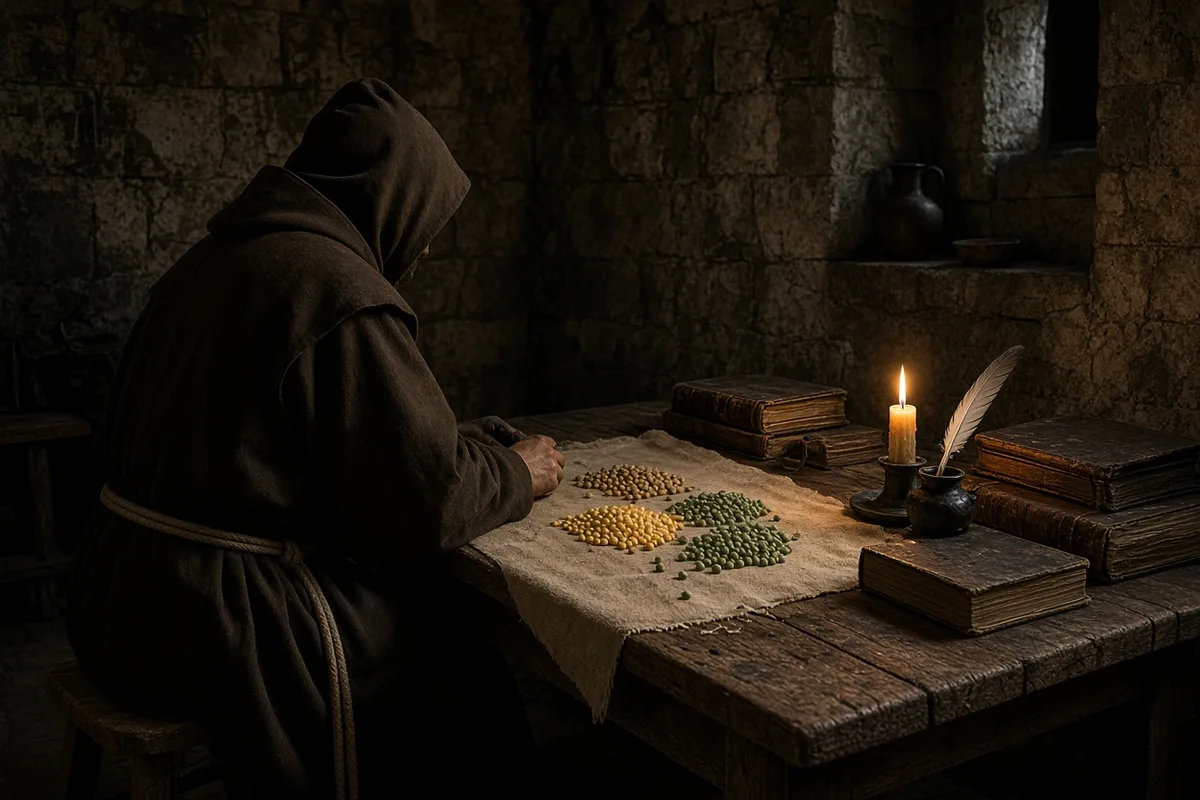
I did not grasp the size of what that meant, not then. I understood only that the man who had once been called too timid for a parish had spent eight years proving that heredity was not fog and mixture but something closer to a ledger, entries kept precise, nothing ever truly lost between one generation and the next.
By the winter of 1865 he was ready to say so out loud, and I was the one who packed the folder of papers and the sample boxes into the cart for the ride into Brno, to the hall of the Natural Science Society. I stood near the back on the eighth of February, among men in good coats who had come to hear a monk from the monastery garden talk about garden peas, and I watched him take his place at the front looking exactly as uncertain of the crowd as his old mentor had once feared he'd be with a congregation. His voice did not carry well. He read from prepared pages rather than speak loosely, working through the crosses, the ratios, the tall and short, the round and wrinkled, laying out eight years of counted rows in the space of an evening.
There was polite attention in that room, and there was, as far as I could tell from where I stood, very little understanding of what they were being handed. Men nodded. Men made notes. Nobody in that hall rose up and told him he had just overturned the whole architecture of blended inheritance, because I do not think anybody there, myself very much included, had the instrument in his head yet to measure the size of the thing.
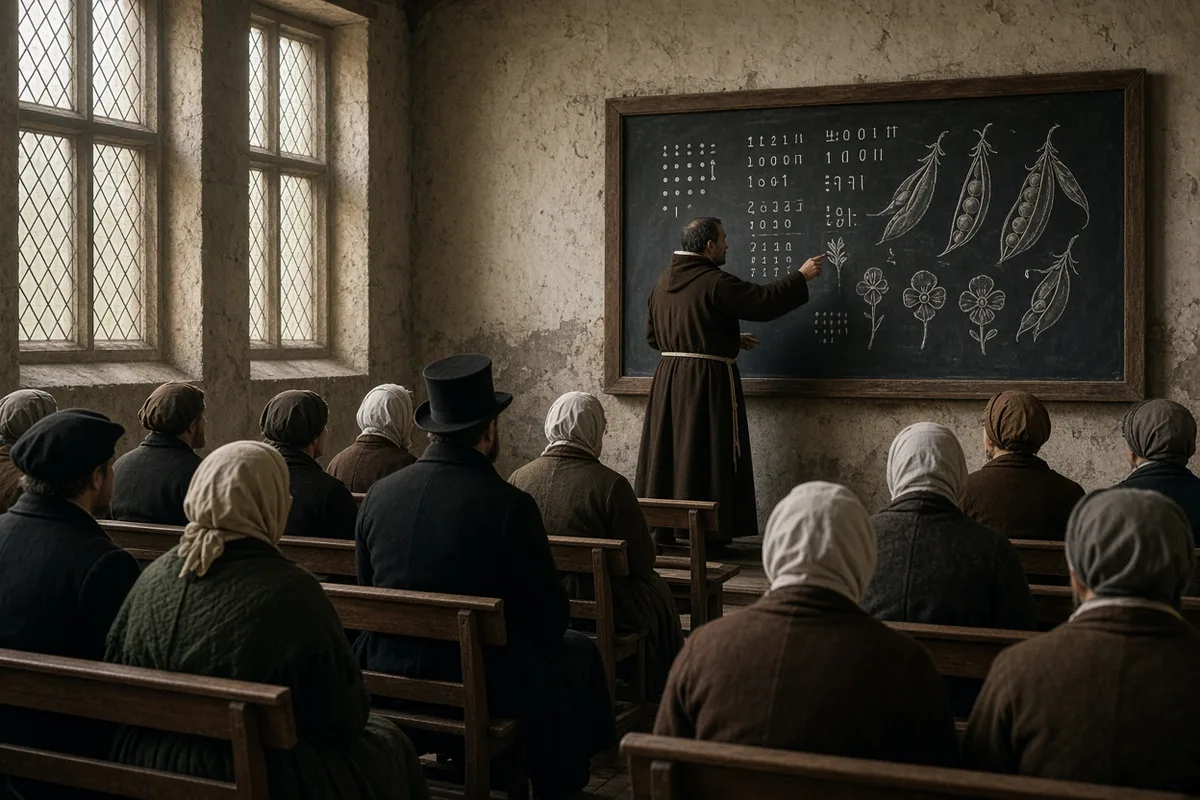
He came back a second time, on the eighth of March, to finish what the first evening's talk had only begun — the mathematics of it, the deeper explanation of why three parts tall to one part short kept turning up, cross after cross, as if the peas themselves were following a law written down somewhere before he ever planted a single seed. I stood at the back again. The room was, if anything, quieter than before. I remember the cold coming off the windows and the sound of his own papers shuffling and very little else, and I remember thinking that a discovery could apparently arrive in the world with almost no noise at all, the way frost comes, overnight and unannounced.
He put the whole of it into a monograph the following year, printed and sent out to whatever libraries and learned men might care to read it, and then, as far as the wider world was concerned, that was the end of the matter. The garden went on. The seasons turned over the way they always had. He was elected abbot himself eventually, and the duties of running the monastery's affairs, its finances, its disputes with the state over taxation, ate away at the hours he had once given so completely to the pea beds. I saw less of him among the trellises as the years went by, more of him at the abbey's ledgers of a different kind, and something in me understood, without being told, that the garden work as I had known it was finished.
He died in 1884, and I stood among the others at the monastery when they laid him to rest, and if anyone in that gathering believed his eight years among the peas would be remembered by the wider world, they kept it to themselves. For a long while it looked as if Abbot Napp's old worry had come true after all — not that the monastery would be laughed at, but worse, that the whole labor would simply be forgotten, filed away in a botanical journal nobody thought to reread.
It was sixteen years, they tell me now, before other men working on their own plants, in their own gardens far from Brno, went looking through the old journals for anything that might explain what they themselves were seeing, and found his monograph waiting there exactly as he had left it, patient as a planted seed. By then he could not be told that he had been right, or that his letters, his little capitals and small letters standing in for hidden and visible traits, would become the working alphabet of an entire science not yet given its name.
I think of him still bent over that third row in the cold, checking numbers he already knew were correct, and I understand now what I only felt then without words for it — that a man can hand the world its future in a monastery garden and be gone from it before anyone thinks to say thank you. The peas kept his secret faithfully, generation folded into generation, three to one, tall over short, round over wrinkled, exactly as he had written it down.