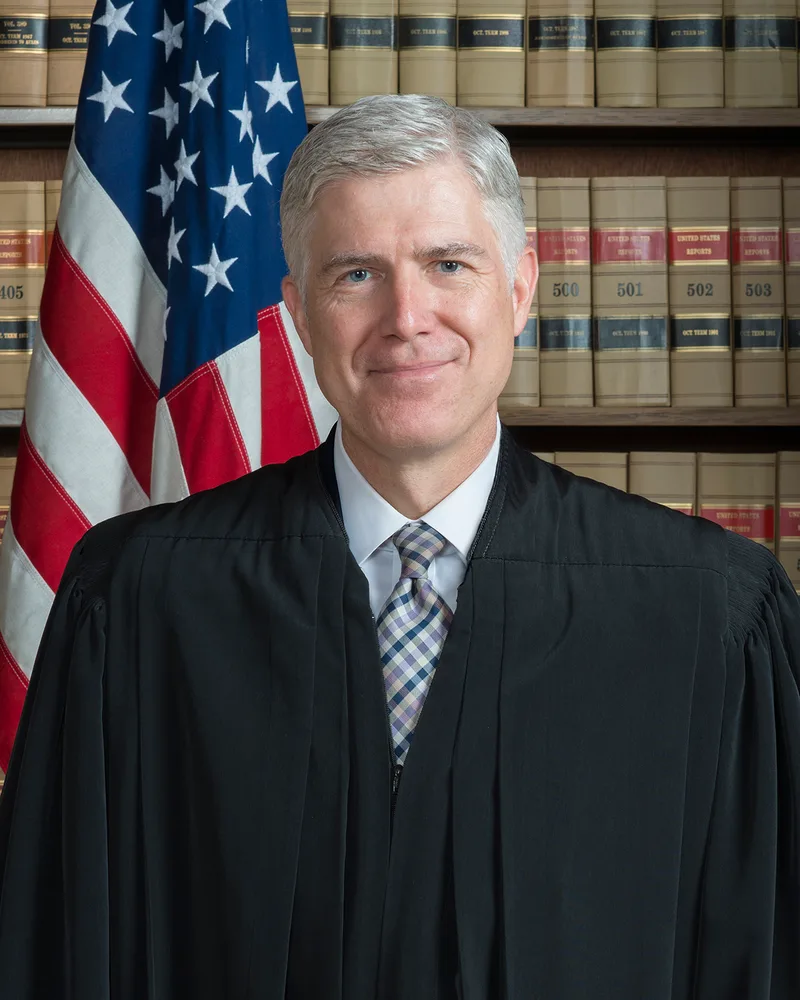
Neil McGill Gorsuch
Justice, Supreme Court of the United States · Born 1967 · Denver, CO
Get above the noise
Log in for answers tailored to you — saved chats, your topics, and the full IJR suite.
Justice, Supreme Court of the United States · Born 1967 · Denver, CO
Doe v. Hochul
Supreme Court of the United States · 2026-06-29
The case involved New York healthcare workers, including a Christian Scientist employee identified as John Doe 2, who were fired after refusing COVID-19 vaccines on religious grounds following the state's elimination of a religious exemption from its vaccine mandate for such workers. The plaintiffs sued their employers under Title VII of the Civil Rights Act of 1964, alleging religious discrimination and proposing accommodations such as testing and masking; the district court dismissed the claims, and the Second Circuit affirmed, holding that violating the state regulation would impose an "undue hardship" as a matter of law. The Supreme Court denied certiorari. In dissent, Justice Gorsuch, joined by Justices Thomas and Alito, contended that the Second Circuit's approach was mistaken because Title VII's text and purpose allow federal law to preempt inconsistent state mandates, that other federal civil rights statutes are interpreted to prevent state law from nullifying accommodations or defenses, and that treating state law as automatically creating undue hardship would undermine federal protections.
religious libertycivil rightshealthcarefederal power
Landor v. Louisiana Dept of Corrections and Public Safety
Supreme Court of the United States · 2026-06-23
The case involved Damon Landor, a Rastafarian inmate, who sued the Louisiana Department of Corrections and its individual officers under the Religious Land Use and Institutionalized Persons Act (RLUIPA) after officers forcibly shaved his head in violation of his religious beliefs, seeking money damages from the officers personally. The Supreme Court held that RLUIPA does not authorize suits for damages against state employees in their personal capacities. The Court reasoned that RLUIPA was enacted pursuant to Congress’s Spending Clause authority, which permits conditions on federal funds but does not allow direct regulation of conduct or imposition of sanctions without the voluntary and knowing consent of those subject to them, as established by contract-law analogies in precedents like Pennhurst. Because the individual officers had entered no agreement with the federal government and thus had not consented to personal liability, Landor’s claims against them could not proceed.
religious libertycivil rightsfederal powercriminal law
Landor v. Louisiana Dept of Corrections and Public Safety Revisions: 6/24/26
Supreme Court of the United States · 2026-06-23
In Landor v. Louisiana Department of Corrections and Public Safety, inmate Damon Landor, a Rastafarian whose faith requires uncut hair, sued the state prison system and several officers under the Religious Land Use and Institutionalized Persons Act (RLUIPA) after officers forcibly shaved his head despite knowing his beliefs, seeking money damages from the officers in their personal capacities. The Supreme Court held that RLUIPA does not authorize such suits against individuals who have not consented to personal liability. The Court explained that RLUIPA rests on Congress’s Spending Clause authority, which permits conditions on federal funds but does not allow Congress to impose additional sanctions like personal damages without the voluntary and knowing consent of those bound; because the officers never entered any agreement with the federal government, they could not be sued under the statute, consistent with contract-law principles that limit liability to actual parties to the bargain.
religious libertycriminal lawcivil rightsfederal power
United States v. Hemani
Supreme Court of the United States · 2026-06-18
In United States v. Hemani, the government prosecuted a U.S. citizen under 18 U.S.C. §922(g)(3) for possessing a firearm in his home while being an unlawful user of marijuana, based solely on his admission of using the drug every other day; the defendant moved to dismiss, arguing a Second Amendment violation. The Supreme Court affirmed the district court’s dismissal of the indictment. Applying the framework from New York State Rifle & Pistol Assn., Inc. v. Bruen, the Court held that the statute’s automatic, categorical disarmament of anyone who unlawfully uses a controlled substance burdens conduct presumptively protected by the Second Amendment. The government’s analogy to historical “habitual drunkard” laws (vagrancy statutes, civil-commitment proceedings, and surety-of-good-behavior requirements) failed because those laws generally addressed individuals rendered incapacitated by intoxication, pursued different purposes such as promoting productivity or protecting families from financial harm, and typically required individualized process before depriving anyone of liberties—features absent from the modern provision’s automatic and broad application tied to the Controlled Substances Act. The decision is narrow and does not address laws targeting addicts, those presently intoxicated, or prosecutions supported by individualized evidence of dangerousness.
gunscriminal law
Sripetch v. SEC
Supreme Court of the United States · 2026-06-04
In Sripetch v. SEC, the Securities and Exchange Commission brought a civil enforcement action against Ongkaruck Sripetch for securities fraud involving multiple penny-stock schemes and sought over $4.1 million in disgorgement after he consented to judgment. Sripetch argued that disgorgement was unavailable under Liu v. SEC because the SEC had not shown investors suffered pecuniary losses, and lower courts were split on whether such proof was required. The Supreme Court held that a showing of pecuniary loss to investors is not required before the SEC may obtain disgorgement. The Court reasoned that, under traditional equitable principles, disgorgement deprives wrongdoers of net profits from unlawful activity and may be awarded to remedy interference with a victim’s legally protected interests even if the victim suffered no measurable financial loss, and that Liu imposed no contrary pecuniary-loss requirement.
business & regulatory
Flowers Foods, Inc. v. Brock
Supreme Court of the United States · 2026-05-28
The case concerned whether the Federal Arbitration Act’s exemption for “contracts of employment” of workers “engaged in... interstate commerce” (9 U.S.C. §1) applied to a Colorado-based franchisee who picked up and delivered Flowers Foods’ baked goods entirely within the state as part of an interstate distribution chain. The Supreme Court affirmed the Tenth Circuit’s ruling that the exemption covered such workers, so the FAA did not require enforcement of the arbitration agreement Brock had signed. The Court held that the statutory text does not require a worker to cross state lines or interact with vehicles that do, because interstate commerce encompasses the full continuous journey of goods between states, including intrastate segments. This reading was supported by the ordinary meaning of the terms at the time of the FAA’s enactment and by precedents such as The Daniel Ball, which treated intrastate actors participating in interstate transport as engaged in interstate commerce. Flowers’ proposed bright-line rule limiting the exemption to those who cross state lines or touch cross-border vehicles was rejected as unsupported by the statute.
labor & employmentbusiness & regulatoryfederal powerprocedure
First Choice Women's Resource Centers, Inc. v. Davenport
Supreme Court of the United States · 2026-04-29
In First Choice Women’s Resource Centers, Inc. v. Davenport, a religious nonprofit that provides pregnancy counseling challenged a subpoena from New Jersey’s Attorney General seeking extensive donor information, including names and contact details, arguing that the demand violated its First Amendment associational rights by deterring donors. The district court dismissed the case for lack of standing, and the Third Circuit affirmed, holding that no injury occurred until a court enforced the subpoena. The Supreme Court reversed, ruling that First Choice established a present injury in fact sufficient for Article III standing. The Court reasoned that official demands for private donor information inherently burden associational rights by discouraging protected speech and association, creating an ongoing harm from the moment the demand is made, regardless of enforcement or later confidentiality measures.
free speechreligious libertyprocedure
Chiles v. Salazar Revisions: 3/31/26
Supreme Court of the United States · 2026-03-31
Kaley Chiles, a licensed Colorado counselor who provides only talk therapy, sued state officials to block enforcement of a 2019 law that prohibits licensed mental-health professionals from engaging in “conversion therapy” with minors, defined to include any effort to change a client’s sexual orientation, gender identity, behaviors, or attractions. The law expressly permits counselors to offer acceptance, support, and assistance for clients exploring or affirming their identity or undergoing gender transition. Both the district court and the Tenth Circuit upheld the law against Chiles’s First Amendment challenge, treating it as a regulation of professional conduct that incidentally affects speech and therefore subject only to rational-basis review. The Supreme Court reversed, holding that the statute, as applied to Chiles’s conversations with clients, regulates speech on the basis of its content and viewpoint by allowing some messages about gender and sexuality while forbidding others, and that such restrictions require heightened First Amendment scrutiny rather than rational-basis review.
free speechcivil rightshealthcare
Chiles v. Salazar
Supreme Court of the United States · 2026-03-31
Kaley Chiles, a licensed Colorado counselor who provides only talk therapy, sued state officials to block enforcement of a 2019 law that prohibits licensed mental health professionals from engaging in “conversion therapy” with minors, defined to include any effort to change a client’s sexual orientation, gender identity, behaviors, or attractions, while expressly permitting counseling that supports identity exploration or gender transition. Both the district court and the Tenth Circuit denied her request for a preliminary injunction, holding that the law primarily regulates professional conduct and only incidentally burdens speech, so rational-basis review applied. The Supreme Court reversed, ruling that the statute, as applied to Chiles’s conversations with clients, regulates speech on the basis of its content and viewpoint. The Court explained that the First Amendment protects licensed professionals’ speech and that laws targeting speech because of the views expressed are presumptively unconstitutional and must satisfy strict scrutiny, rather than the more lenient standard used for non-expressive conduct.
free speechcivil rightshealthcare
Rico v. United States
Supreme Court of the United States · 2026-03-25
In Rico v. United States, the Supreme Court addressed whether a defendant’s abscondment from federal supervised release automatically extends the term beyond the date set by the sentencing judge, allowing crimes committed afterward to count as violations. Petitioner Isabel Rico had her supervised release revoked after she failed to report a change of address and later committed a state drug offense while a fugitive; the district court treated the offense as a Grade A violation and imposed additional prison time and supervised release, a result affirmed by the Ninth Circuit on the theory that her abscondment tolled the clock. The Court held that the Sentencing Reform Act does not authorize any such automatic-extension rule. It reasoned that the Act expressly fixes the start of supervised release on the day of release from prison, caps its length by offense severity, and provides only limited, court-supervised mechanisms for extension or tolling (such as during lengthy imprisonment or after a revocation hearing), none of which contemplate or permit an automatic extension for abscondment.
criminal lawprocedure
Burnett v. United States
Supreme Court of the United States · 2026-03-09
In Burnett v. United States, the petitioner, who had pleaded guilty to a federal crime carrying a 120-month statutory maximum, challenged two later prison terms imposed for supervised release violations that brought his total incarceration to 132 months. The district court, affirmed by the court of appeals, found the violations by a preponderance of the evidence without a jury and imposed additional prison time exceeding the original maximum. The Supreme Court denied certiorari. Justice Gorsuch dissented, arguing that the case presented an unresolved question under Apprendi v. New Jersey and the Sixth Amendment: whether any fact increasing a defendant's total prison time beyond the statutory maximum for the crime of conviction must be submitted to a jury and proved beyond a reasonable doubt.
criminal lawprocedure
Veneno v. United States
Supreme Court of the United States · 2025-11-10
In Veneno v. United States, petitioner Quentin Veneno, Jr. asked the Supreme Court to grant certiorari and reconsider its 1886 decision in United States v. Kagama, which upheld the Major Crimes Act's grant of federal authority to prosecute certain serious crimes committed by Native Americans against other Native Americans on tribal lands. The Court denied the petition. In a dissent joined by Justice Thomas, Justice Gorsuch contended that Kagama rests on an extra-constitutional theory of federal "plenary power" over tribal internal affairs, one that cannot be justified by the Indian Commerce Clause, the Territories Clause, or any other enumerated power, and that instead reflects only the era's assumptions rather than constitutional text or original tribal sovereignty.
criminal lawfederal power
Thomas v. Humboldt Cty.
Supreme Court of the United States · 2025-10-14
The case concerned a petition for Supreme Court review by Corrine Morgan Thomas and others, who challenged actions by Humboldt County, California, and sought to overturn the 1916 precedent in Minneapolis & St. Louis R. Co. v. Bombolis, which held that the Seventh Amendment’s civil jury trial right does not apply to the states. The Supreme Court denied the petition for a writ of certiorari. Justice Gorsuch issued a statement agreeing with the denial due to procedural vehicle problems in the case that made it an unsuitable vehicle for reconsidering Bombolis. He noted, however, that the precedent is inconsistent with the Court’s modern incorporation doctrine under the Fourteenth Amendment, under which most other Bill of Rights protections—including jury-related rights—have been applied to the states, and that historical evidence shows the civil jury right was widely regarded as fundamental at the time of the Fourteenth Amendment’s ratification.
civil rightsprocedure
National Institutes of Health v. American Public Health Assn.
Supreme Court of the United States · 2025-08-21
The case concerned challenges by researchers and public health groups to the National Institutes of Health’s termination of numerous research grants and its internal guidance implementing executive orders that barred funding for projects involving DEI, gender identity, COVID-19, or race-based criteria. The district court vacated both the terminations and the guidance under the Administrative Procedure Act, and the First Circuit denied the government’s request for a stay. The Supreme Court granted a partial stay, blocking enforcement of the district court’s orders vacating the grant terminations while leaving in place the vacatur of the guidance documents. It reasoned that the APA’s limited waiver of sovereign immunity does not give district courts jurisdiction over claims seeking to enforce obligations to pay money under grants, which must instead be brought in the Court of Federal Claims, and that the government would suffer irreparable harm from unrecoverable expenditures; however, challenges to the guidance itself were viewed as distinct and within district court authority. The partial stay remains in effect pending further appellate proceedings.
civil rightshealthcarefederal powerprocedure
Medina v. Planned Parenthood South Atlantic
Supreme Court of the United States · 2025-06-26
The case concerned whether Medicaid beneficiaries can sue state officials under 42 U.S.C. § 1983 to enforce the “any-qualified-provider” provision of the Medicaid Act, 42 U.S.C. § 1396a(a)(23)(A), which requires states to let eligible individuals obtain covered services from any qualified provider who undertakes to furnish them. South Carolina had terminated Planned Parenthood’s participation in its Medicaid program under a state law barring public funds for abortion providers, prompting a lawsuit by the organization and a patient who preferred its services. The Supreme Court held that the provision does not create an individually enforceable right under § 1983. The Court reasoned that statutes enacted under the Spending Clause, such as Medicaid, are presumed not to confer privately enforceable rights unless they contain clear, unambiguous “rights-creating” language focused on individuals, and that the statute’s primary enforcement mechanism is the Secretary’s ability to withhold federal funds rather than private litigation.
abortionhealthcarecivil rightsfederal power
Medina v. Planned Parenthood South Atlantic
Supreme Court of the United States · 2025-06-26 · cited 40×
The case concerned whether Medicaid beneficiaries in South Carolina could sue state officials under 42 U.S.C. §1983 to enforce the Medicaid Act’s “any-qualified-provider” provision, 42 U.S.C. §1396a(a)(23)(A), after the state excluded Planned Parenthood from its Medicaid program because the organization performs abortions. The Supreme Court held that the provision does not confer individual rights enforceable through §1983. The Court reasoned that spending-power statutes like Medicaid create privately enforceable rights only in atypical cases where Congress uses unambiguous “rights-creating” language with an unmistakable focus on individual beneficiaries; here, the statute instead imposes conditions on state plans as part of a funding bargain, with the ordinary remedy for noncompliance being the withholding of federal funds rather than private litigation.
abortionhealthcarecivil rightsfederal power
Stanley v. City of Sanford
Supreme Court of the United States · 2025-06-20 · cited 19×
Karyn Stanley, a firefighter who retired in 2018 due to disability, sued the City of Sanford under Title I of the Americans with Disabilities Act after the city provided her only 24 months of post-retirement health insurance, while offering coverage until age 65 for retirees with 25 years of service. The district court and Eleventh Circuit dismissed the claim, and the Supreme Court affirmed. The Court held that Section 12112(a) requires a plaintiff to show she was a “qualified individual” who held or desired a job and could perform its essential functions at the time of the alleged discrimination. This reading follows from the statute’s use of present-tense verbs in defining “qualified individual,” the focus of its reasonable-accommodation and discrimination examples on current employees or applicants, and comparisons to Title VII precedent. The decision therefore bars ADA claims by retirees challenging the terms of post-employment benefits.
civil rightslabor & employmenthealthcare
Stanley v. City of Stanford
Supreme Court of the United States · 2025-06-20 · cited 8×
Karyn Stanley, a firefighter forced to retire in 2018 due to disability, sued the City of Sanford under Title I of the Americans with Disabilities Act, alleging that its policy—providing health insurance until age 65 only to retirees with 25 years of service, but just 24 months to those retiring earlier due to disability—constituted unlawful discrimination in compensation. The district court and Eleventh Circuit dismissed the claim, and the Supreme Court affirmed. The Court held that §12112(a) requires a plaintiff to be a “qualified individual” who, at the time of the alleged discrimination, holds or desires a job and can perform its essential functions with or without reasonable accommodation. It reasoned that the statute’s use of present-tense verbs, its definitions of “reasonable accommodation” and examples of prohibited conduct, and its contrast with broader Title VII language all indicate protection for current employees or applicants rather than retirees; the Court rejected Stanley’s alternative reading as inconsistent with ordinary statutory meaning.
civil rightslabor & employment
Martin v. United States
Supreme Court of the United States · 2025-06-12
The case arose when FBI agents, executing warrants for a suspected gang hideout, raided the wrong suburban Atlanta home due to a GPS error and failure to check visible street signs and house numbers, injuring the innocent occupants and damaging their property. The family sued the United States under the Federal Tort Claims Act (FTCA) for negligence and intentional torts such as assault and battery. The Supreme Court held that the FTCA’s law-enforcement proviso in 28 U.S.C. §2680(h) overrides only the intentional-tort exception in that same subsection and does not automatically displace the discretionary-function exception in §2680(a) or other exceptions. The Court rejected the Eleventh Circuit’s distinctive approach, which had allowed covered intentional-tort claims to proceed without analyzing other exceptions and then permitted a broad Supremacy Clause defense on the merits. It remanded for proper application of the two-step discretionary-function test while taking account of the proviso’s context and purpose.
torts & liabilityprocedurefederal power
Martin v. United States
Supreme Court of the United States · 2025-06-12 · cited 24×
The case arose after an FBI SWAT team executed warrants at the wrong suburban Atlanta address in 2017, breaching the home of Curtrina Martin, Hilliard Cliatt, and their child and causing injuries and property damage; the family sued the United States under the Federal Tort Claims Act for both negligent and intentional torts. The Supreme Court held that the law-enforcement proviso in 28 U.S.C. §2680(h) overrides only the intentional-tort exception in that same subsection and does not displace the discretionary-function exception in §2680(a) or any other FTCA exceptions. The Court reasoned that the proviso’s placement within subsection (h), its limited definitional sentence, and the separate sentence structure of each statutory exception show that Congress intended it to address only intentional-tort immunity, leaving other defenses such as discretionary-function analysis to be applied independently to the claims.
torts & liabilityfederal powerprocedure