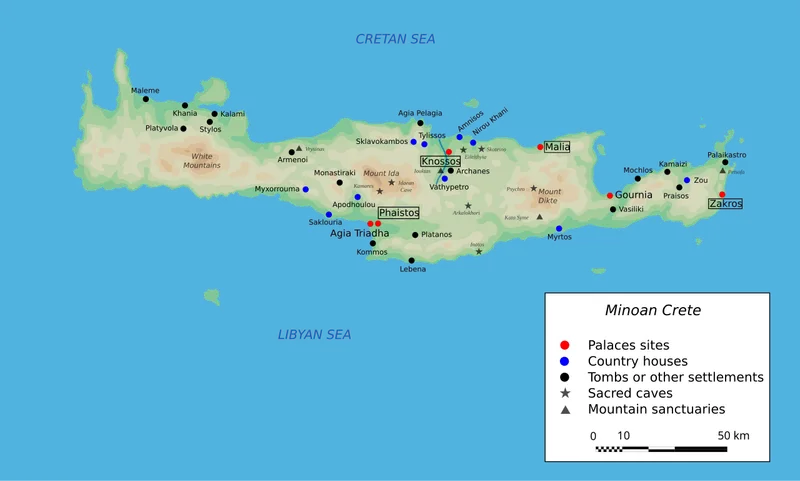
Overview
The Minoan civilization was a Bronze Age culture which was centered on the island of Crete. Known for its monumental architecture and its energetic art, it is often regarded as the first civilization in Europe.
The Minoan civilization developed from the local Neolithic culture around 3100BC, with complex urban settlements beginning around 2000BC. After 1450BC, they came under the cultural and perhaps political domination of the mainland Mycenaean Greeks, forming a hybrid culture which lasted until around 1100BC.
The Minoans constructed enormous buildings which their initial excavators labeled Minoan palaces. Subsequent research has shown that they served a variety of religious and economic purposes rather than being royal residences, though their exact role in Minoan society is a matter of continuing debate. The palaces consisted of a large rectangular court surrounded by multistory wings with labyrinthine floorplans. The ruins of the palaces at Knossos and Phaistos are popular tourist attractions.
Minoan art included elaborately decorated pottery, seals, figurines, and colorful frescoes. They are believed to have invented true fresco, a technique which results in the pigment becoming part of the wall. Typical subjects include nature and ritual. Minoan art is often described as having a fantastical or ecstatic quality, with figures rendered in a manner suggesting motion.
From Wikipedia (CC BY-SA 4.0).