Overview
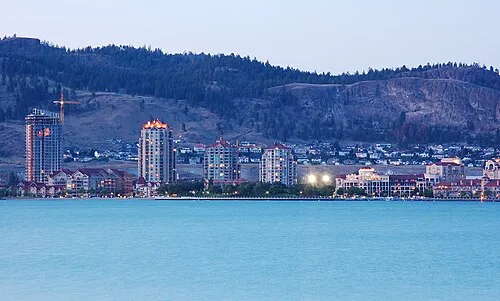
Kelowna is a city on Okanagan Lake in the Okanagan Valley in the southern interior of British Columbia, Canada. It serves as the head office of the Regional District of Central Okanagan. The name Kelowna derives from the Okanagan word , referring to a grizzly bear.
Kelowna is the province's third-largest metropolitan area (after Vancouver and Victoria), while it is the seventh-largest city overall and the largest in the Interior. It is the 20th-largest metropolitan area in Canada. The city proper encompasses , and the census metropolitan area . Kelowna's estimated population in 2020 is 222,748 in the metropolitan area and 142,146 in the city proper. After a period of suburban expansion into the surrounding mountain slopes, the city council adopted a long-term plan intended to increase density instead — particularly in the downtown core. This has resulted in the construction of taller buildings, including One Water Street — a 36-story building that is the tallest in Kelowna. Other highrise developments have already broken ground or been approved since then, including a 42-storey tower on Leon Avenue which will be the tallest building in the city, and among the tallest in B.C.
Nearby communities include the City of West Kelowna (also referred to as Westbank and Westside) to the west, across Okanagan Lake; Lake Country and Vernon to the north; Peachland to the southwest; and Summerland and Penticton to the south.
History
The exact dates of first settlement in the Okanagan Valley are unknown, but a northern migration led to the habitation of this area some 9,000 years ago. The Indigenous Syilx people are the first known inhabitants of the region, where they continue to live today.
From Wikipedia (CC BY-SA 4.0).