Overview
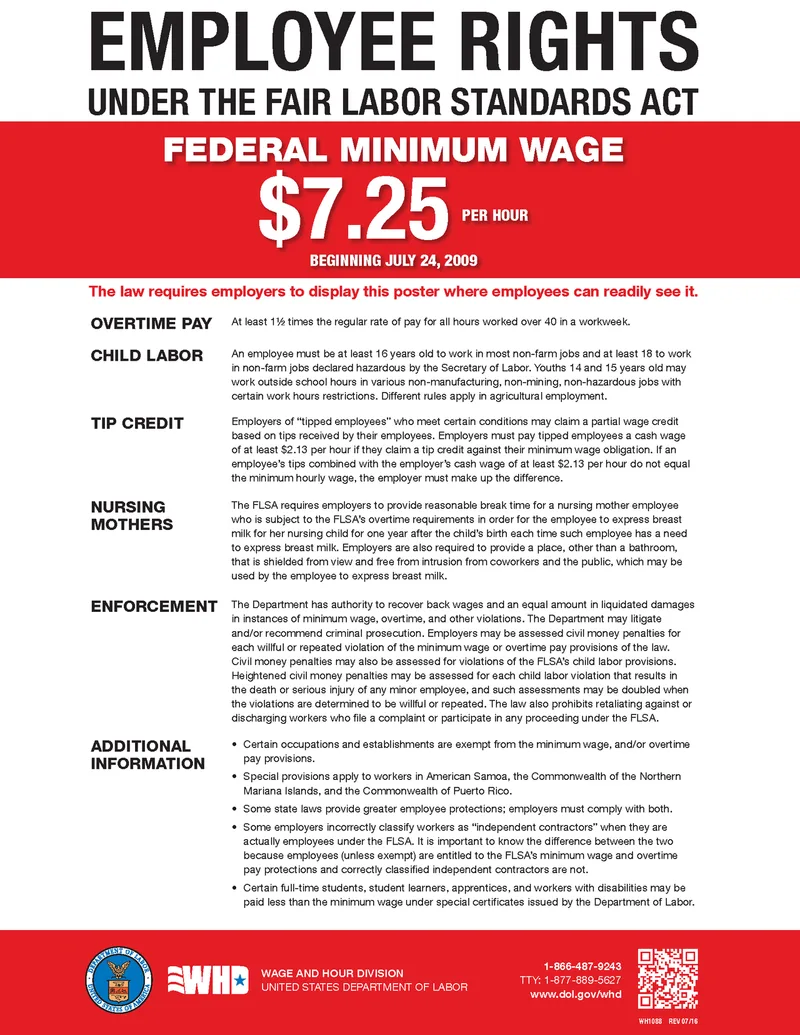
The Fair Labor Standards Act of 1938 (FLSA) is a United States labor law that creates the right to a minimum wage, and "time-and-a-half" overtime pay when people work over forty hours a week. It also prohibits employment of minors in "oppressive child labor". It applies to employees engaged in interstate commerce or employed by an enterprise engaged in commerce or in the production of goods for commerce, unless the employer can claim an exemption from coverage. The Act was enacted by the 75th Congress and signed into law by President Franklin D. Roosevelt in 1938.
Practical application
The Fair Labor Standards Act applies to "employees who are engaged in interstate commerce or in the production of goods for commerce, or who are employed by an enterprise engaged in commerce or in the production of goods for commerce" unless the employer can claim an exemption from coverage. Generally, an employer with at least $500,000 of business or gross sales in a year satisfies the commerce requirements of the FLSA, and therefore that employer's workers are subject to the Fair Labor Standards Act's protections if no other exemption applies. Several exemptions exist that relieve an employer from having to meet the statutory minimum wage, overtime, and record-keeping requirements. The largest exceptions apply to the so-called "white collar" exemptions that are applicable to professional, administrative and executive employees, though exemptions also exist for jobs such as movie theater workers. Exemptions are narrowly construed, as an employer must prove that the employees fit "plainly and unmistakably" within the exemption's terms.
The Fair Labor Standards Act applies to "any individual employed by an employer" but not to independent contractors or volunteers because they are not considered "employees" under the FLSA. Still, an employer cannot simply exempt workers from the Fair Labor Standards Act by calling them independent contractors, and many employers have illegally and incorrectly classified their workers as independent contractors. Some employers similarly mislabel employees as volunteers. Courts look at the "economic reality" of the relationship between the putative employer and the worker to determine whether the worker is an independent contractor. Courts use a similar test to determine whether a worker was concurrently employed by more than one person or entity; commonly referred to as "joint employers".
From Wikipedia (CC BY-SA 4.0).