Overview
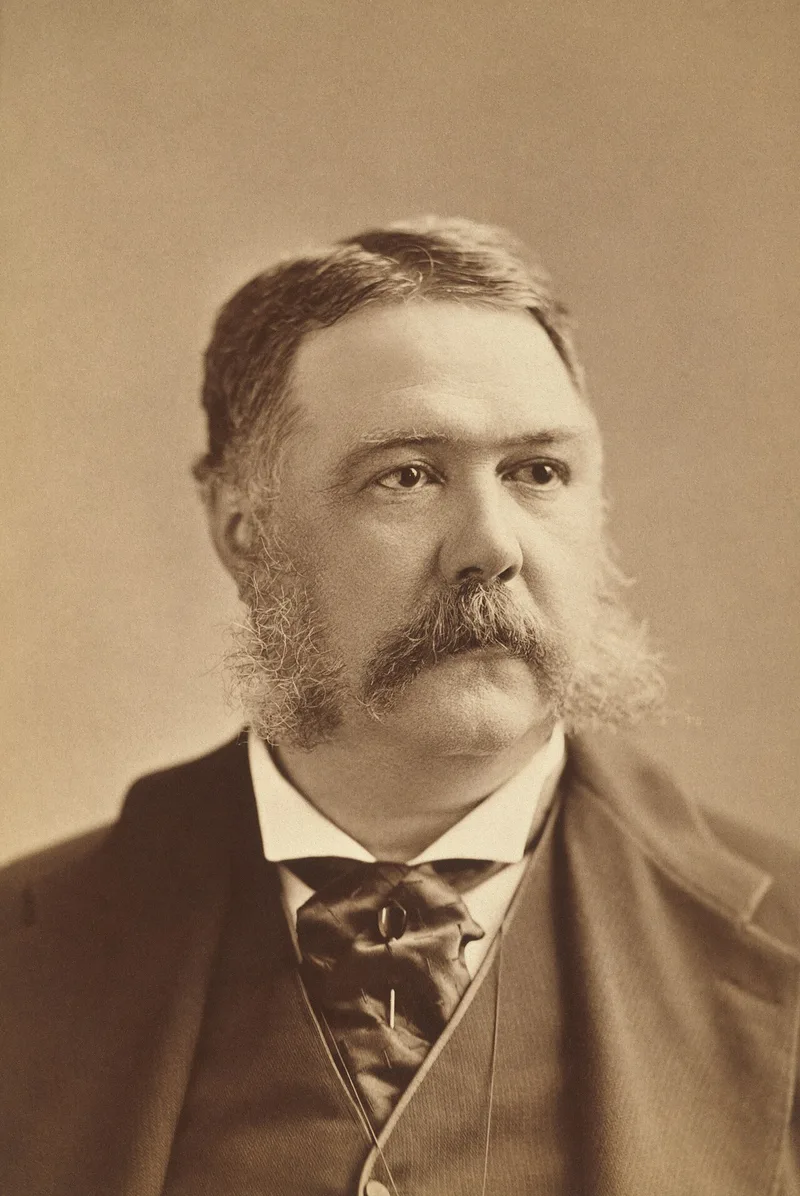
Chester Alan Arthur (October 5, 1829 – November 18, 1886) was an American politician who served as the 21st president of the United States from 1881 to 1885. He was a Republican lawyer from New York who previously served as the 20th vice president under President James A. Garfield. Arthur assumed the presidency after Garfield's death on September 19, 1881, and served the remainder of his term until March 4, 1885.
Arthur was born in Fairfield, Vermont, grew up in upstate New York and practiced law in New York City. He served as quartermaster general of the New York Militia during the American Civil War. Following the war, he devoted more time to New York Republican politics and quickly rose in Senator Roscoe Conkling's political organization. President Ulysses S. Grant appointed him as Collector of the Port of New York in 1871, and he was an important supporter of Conkling and the Stalwart faction of the Republican Party. In 1878, following bitter disputes between Conkling and President Rutherford B. Hayes over control of patronage in New York, Hayes fired Arthur as part of a plan to reform the federal patronage system. In June 1880, the extended contest between Grant, identified with the Stalwarts, and James G. Blaine, the candidate of the Half-Breed faction, led to the compromise selection of Ohio's Garfield for president. Republicans then nominated Arthur for vice president to balance the ticket geographically and to placate Stalwarts disappointed by Grant's defeat. Garfield and Arthur won the 1880 presidential election and took office in March 1881. Four months into his term, Garfield was shot by an assassin; he died 11 weeks later, and Arthur assumed the presidency.
As president, Arthur presided over the rebirth of the US Navy, but he was criticized for failing to alleviate the federal budget surplus which had been accumulating since the end of the Civil War. Arthur vetoed the first version of the 1882 Chinese Exclusion Act, arguing that its twenty-year ban on Chinese immigrants to the United States violated the Burlingame Treaty, but he signed a second version, which included a ten-year ban. He appointed Horace Gray and Samuel Blatchford to the Supreme Court. He also enforced the Immigration Act of 1882 to impose more restrictions on immigrants and the Tariff of 1883 to attempt to reduce tariffs.
From Wikipedia (CC BY-SA 4.0).