Overview
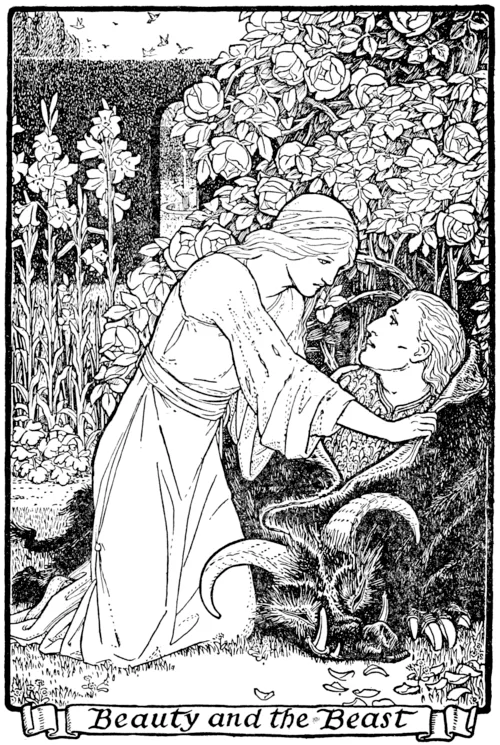
"Beauty and the Beast" is a fairy tale written by French novelist Gabrielle-Suzanne Barbot de Villeneuve and published in 1740 in La Jeune Américaine et les contes marins (The Young American and Marine Tales). Her lengthy version was abridged, rewritten, and published by French novelist Jeanne-Marie Leprince de Beaumont in 1756 in Magasin des enfants (Children's Collection) to produce the version most commonly retold. Later, Andrew Lang retold the story in Blue Fairy Book, a part of the Fairy Book series, in 1889. The fairy tale was influenced by Ancient Greek stories such as "Cupid and Psyche" from The Golden Ass, written by Lucius Apuleius Madaurensis in the second century AD, and "The Pig King", an Italian fairytale published by Giovanni Francesco Straparola in The Facetious Nights of Straparola around 1550.<ref>Harrison, "Cupid and Psyche", Oxford Encyclopedia of Ancient Greece and Rome',' p. 339.</ref>
Variants of the tale are known across Europe. In France, for example, Zémire and Azor is an operatic version of the story, written by Marmontel and composed by Grétry in 1771, which had enormous success into the 19th century. Zémire and Azor is based on the second version of the tale. Amour pour amour (Love for Love) by Pierre-Claude Nivelle de La Chaussée is a 1742 play based on de Villeneuve's version. According to researchers at universities in Durham and Lisbon, the story originated about 4,000 years ago.
Plot
Villeneuve's version
A widower merchant lives in a mansion with his twelve children (six sons and six daughters). All his daughters are very beautiful, but the youngest daughter was named "little beauty", for she was the most gorgeous among all of them. She continued to be named "Beauty" until she was a young adult. She was the most lovely, as well as kind, well-read, and pure of heart; while the elder sisters, in contrast, are cruel, selfish, vain, spoiled and were jealous of the little beauty.
From Wikipedia (CC BY-SA 4.0).