
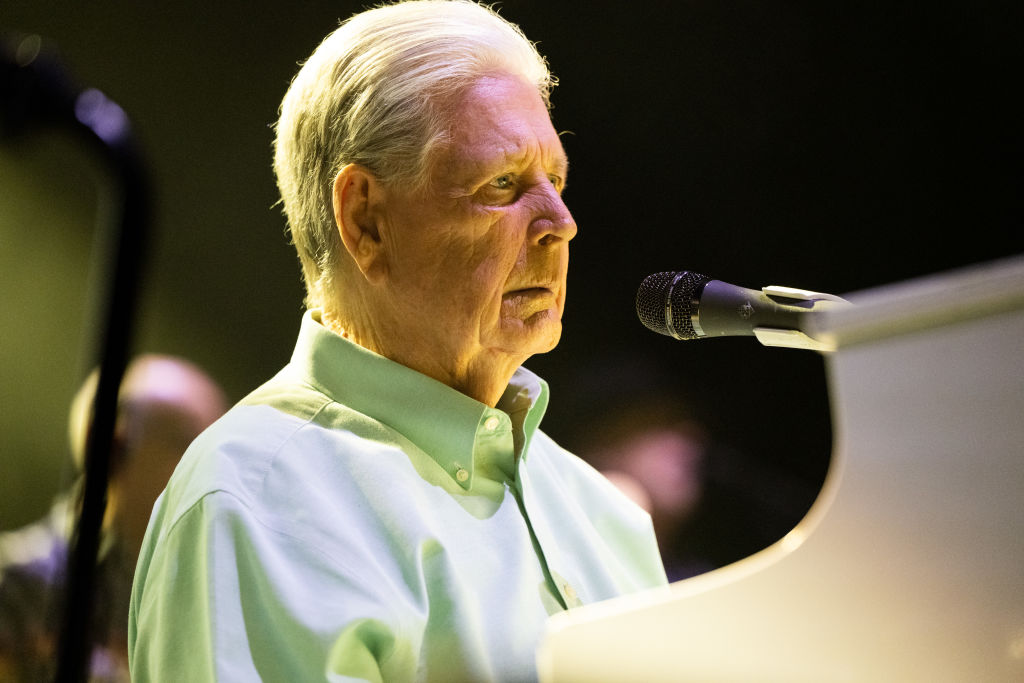

The Beach Boys are an American rock band formed in Hawthorne, California, in 1961. The group's founding members consisted of brothers Brian, Dennis, and Carl Wilson, their cousin Mike Love, and their friend Al Jardine. One of the most popular and influential acts of the rock era, they are known for their musical ingenuity, vocal harmonies, and lyrics initially reflecting a southern California youth culture of surfing, cars, and romance dubbed the "California sound". The group drew on the music of 1950s rock and roll, black R&B, and pre-rock and roll pop vocal groups to create their sound. Under Brian's leadership, they often incorporated classical or jazz elements and unconventional recording techniques in innovative ways.
The band was originally managed by the Wilsons' father Murry and centered on Brian's songwriting, arranging, and producing. Jardine was replaced by David Marks during 1962–1963. Signing with Capitol Records, their second single "Surfin' Safari" (1962) launched a five-year streak of 16 consecutive U.S. top 40 hit singles. Between their releases Surfer Girl (1963) and The Beach Boys Today! (1965), they transitioned to an increasingly orchestral, album-oriented, and studio-focused direction distanced from surf music, after which Brian withdrew from touring and Bruce Johnston substituted for him on tours, later joining as an official member. Released in 1966, the Pet Sounds album and "Good Vibrations" single became widely regarded as among the greatest and most influential works in popular music history. They were one of the few American rock bands to sustain their commercial standing during the British Invasion.
After shelving the Smile album and launching their Brother Records imprint in 1967, the band's commercial and critical momentum in the U.S. faltered and Brian gradually ceded control of the group to his bandmates. Carl took over as de facto leader and produced the bulk of their recordings through the mid-1970s, including Sunflower (1970), Surf's Up (1971), and Holland (1973). Moving to Reprise Records in 1970, Blondie Chaplin and Ricky Fataar of the Flames briefly joined their lineup before Brian reassumed sole producer duties on the albums 15 Big Ones (1976) and The Beach Boys Love You (1977). Amid the continued success of their live shows and Capitol hits compilations, the members splintered into separate factions and pursued solo careers. Dennis drowned in 1983 and Brian was largely estranged from the band by the late 1980s. Following Carl's death from lung cancer in 1998, Jardine left the band and the members granted Love exclusive legal rights to tour under the group's name. Love and Johnston continued to tour as the Beach Boys and temporarily reunited with Brian, Jardine and Marks for the album That's Why God Made the Radio (2012) and accompanying world tour. Brian died in 2025 of respiratory arrest. Since Johnston's departure in 2026, Love continues to tour under the Beach Boys name, whereas Jardine tours separately with Brian's former touring band.
The Beach Boys are one of the most critically acclaimed and commercially successful bands of all time, selling over 100 million records worldwide. They helped legitimize popular music as a recognized art form, and influenced the development of music genres and movements such as psychedelia, power pop, progressive rock, punk, alternative, and lo-fi music. As of 2026, they have had 37 songs reach the top 40 of the U.S. Billboard Hot 100, the most by an American band, with four topping the chart. In 2004, the group was ranked number 12 on Rolling Stone's list of the greatest artists of all time, the highest ranking of any American band. The founding members were inducted into the Rock and Roll Hall of Fame in 1988.
Contents
History
1958–1962: Formation and first recordings
At the time of his 16th birthday on June 20, 1958, Brian Wilson shared a bedroom with his brothers, Dennis and Carl—aged 13 and 11, respectively—in their family home in Hawthorne. He had watched his father Murry Wilson play piano, and had listened intently to the harmonies of vocal groups such as the Four Freshmen. After dissecting songs such as "Ivory Tower" and "Good News", Brian would teach family members how to sing the background harmonies. For his birthday that year, Brian received a reel-to-reel tape recorder. He learned how to overdub, using his vocals and those of Carl and their mother. Brian played piano, while Carl and David Marks, an eleven-year-old longtime neighbor, played guitars that each had received as Christmas presents.
Soon Brian and Carl were avidly listening to Johnny Otis' KFOX radio show. Inspired by the simple structure and vocals of the rhythm and blues songs he heard, Brian changed his piano-playing style and started writing songs. Family gatherings brought the Wilsons in contact with cousin Mike Love. Brian taught Love's sister Maureen and a friend harmonies. Later, Brian, Carl, Love and two friends performed at Hawthorne High School under the name "Carl and The Passions". Brian also knew Al Jardine, a high school classmate. Brian suggested to Jardine that they team up with his cousin and brother Carl. Soon after Dennis also joined the band on demand of the Wilson's mother Audree. Dennis was the only avid surfer in the group, and he suggested that the group write songs that celebrated the sport and the lifestyle that it had inspired in Southern California. Brian finished the song, titled "Surfin'", and with Mike Love, wrote "Surfin' Safari". Love gave the fledgling band its name: "The Pendletones", a pun on "Pendleton", a brand of woolen shirt popular among local surfers at the time.
Murry Wilson, who was an occasional songwriter, arranged for the Pendletones to meet his publisher Hite Morgan. He said: "Finally, [Hite] agreed to hear it, and Mrs. Morgan said 'Drop everything, we're going to record your song. I think it's good.' And she's the one responsible." The band recorded a demo of "Surfin'" with the Morgans. A more professional recording was made sometime later at World Pacific Studio in Hollywood.
In 2015, author James B. Murphy disputed the commonly cited dates of September 15, 1961 for the demo session and October 3 for the studio session, as "no documentation or other verifiable proof" was known to exist from first-hand sources. Murphy placed the group's demo session with the Morgans as taking place in early October 1961, and the World Pacific session in early November. David Marks was not present at the session as he was in school that day.
1962–1969: Capitol era
After being turned down by Dot and Liberty, the Beach Boys signed a seven-year contract with Capitol Records under executive and staff producer Nick Venet. On June 4, 1962, the Beach Boys debuted on Capitol with their second single, "Surfin' Safari" backed with "409". "Surfin' Safari" rose to number 14 and found airplay in New York and Phoenix, a surprise for the label. Their debut album, Surfin' Safari, followed in October 1962 and was different from other rock albums of the time in that it consisted almost entirely of original songs, primarily written by Brian with Mike Love and friend Gary Usher. Another unusual feature of the Beach Boys was that, although they were marketed as "surf music", their repertoire bore little resemblance to the music of other surf bands, which was mainly instrumental and incorporated heavy use of spring reverb. For this reason, some of the Beach Boys' early local performances had young audience members throwing vegetables at the band, believing that the group were poseurs.
In January 1963, the Beach Boys recorded their first top-ten single, "Surfin' U.S.A.", which began their long run of highly successful recording efforts. It was during the sessions for this single that Brian made the production decision from that point on to use double tracking on the group's vocals, resulting in a deeper and more resonant sound. The album of the same name followed in March and reached number 2 on the Billboard charts. Its success propelled the group into a nationwide spotlight, and was vital to launching surf music as a national craze, albeit the Beach Boys' vocal approach to the genre, not the original instrumental style pioneered by Dick Dale. Jardine returned in spring 1963 so Brian could make fewer touring appearances.
Released in September, Surfer Girl marked the first time the group used outside musicians on a substantial portion of an LP. Many of them were the musicians Spector used for his Wall of Sound productions. The next month, the group's fourth album Little Deuce Coupe was issued. Additionally, disputes between Marks, his parents, and Murry led Marks to quit that month. In December, the band released a standalone Christmas-themed single "Little Saint Nick", backed with an a cappella rendition of the scriptural song "The Lord's Prayer". The A-side peaked at number 3 on the US Billboard Christmas chart.
The surf music craze, along with the careers of nearly all surf acts, was slowly replaced by the British Invasion. Following a successful Australasian tour in January and February 1964, the Beach Boys returned home to face their new competition, the Beatles. Both groups shared the same record label in the US, and Capitol's support for the Beach Boys immediately began waning. Although it generated a top-five single in "Fun Fun Fun", the group's fifth album, Shut Down Volume 2, became their first since Surfin' Safari not to reach the US top-ten. This caused Murry to fight for the band at the label more than before, often visiting their offices without warning to "twist executive arms", in biographer Peter Ames Carlin's description.
1970–1978: Reprise era
The group was signed to Reprise Records in 1970. Scott Schinder described the label as "probably the hippest and most artist-friendly major label of the time". The deal was brokered by Van Dyke Parks, who was then employed as a multimedia executive at Warner Music Group. Reprise's contract stipulated Brian's proactive involvement with the band in all albums. Their first LP for Reprise, Sunflower, was released on August 31, 1970 and featured a strong group presence with significant writing contributions from all six band members. Brian was active during this period, writing or co-writing seven of Sunflower's 12 songs and performing at half of the band's domestic concerts in 1970. The album received critical acclaim in both the US and the UK.
In early 1970, the Beach Boys hired radio presenter Jack Rieley as their manager. One of his initiatives was to encourage the band to record songs with more socially conscious lyrics. He requested the completion of Smile track "Surf's Up" and arranged a guest appearance at a Grateful Dead concert at Bill Graham's Fillmore East in April 1971 to foreground the Beach Boys' transition into the counterculture. During this time, the group ceased wearing matching uniforms on stage, while Dennis starred alongside James Taylor, Laurie Bird, and Warren Oates in the film Two-Lane Blacktop, released in 1971. In July, the American music press rated the Beach Boys "the hottest grossing act" in the country, tied with Grand Funk Railroad. The band filmed a concert for ABC-TV in Central Park, which aired as Good Vibrations from Central Park on August 19.
On August 30, the band released Surf's Up, which was moderately successful, reaching the US top-thirty, a marked improvement over their recent releases. While the record charted, the Beach Boys added to their renewed fame by performing a near-sellout set at Carnegie Hall; their live shows during this era included reworked arrangements of many of their previous songs, with their set lists culling from Pet Sounds and Smile.
Early 1972 saw the recruitment of two former members of the South African band the Flames, guitarist/singer Blondie Chaplin and drummer/singer Ricky Fataar, into the Beach Boys. Shortly afterwards, Johnston left the band. Rieley said that he fired Johnston at the request of the Wilson brothers; while Johnston himself stated that he quit the band partly due to his unhappiness with Brian's creative withdrawal from the group. The new line-up released Carl and the Passions – "So Tough" in May 1972. The original U.S. release was packaged with a bonus reissue of Pet Sounds. Carl and the Passions was relatively unsuccessful in the U.S., charting at number 50. It was more successful in the UK, where it was issued as a single album without Pet Sounds, peaking at number 25. The next album, Holland, was released in January 1973. Reprise initially rejected the album, feeling it lacked a strong single. Following the intervention of Van Dyke Parks, this resulted in the inclusion of "Sail On, Sailor". Reprise approved, and the resulting album peaked at number 37. Brian's musical children's story, Mount Vernon and Fairway, was included with the album as a bonus EP.
1978–1996: Continued recording, death of Dennis, and Brian's estrangement
The group's first two albums for CBS, 1979's L.A. (Light Album) and 1980's Keepin' the Summer Alive, struggled in the US, charting at 100 and 75 respectively, though the band did manage a top-forty single from L.A. (Light Album) with "Good Timin'". The recording of these albums saw Bruce Johnston return to the band, initially solely as a producer and eventually as a full-time band member. In-between the two albums, the group contributed the song "It's a Beautiful Day" to the soundtrack of the film Americathon.
In the 1980s, the Beach Boys transitioned into an oldies act and spent the next several years touring, often playing in front of large audiences, and recording songs for film soundtracks and various artists compilations. On June 21, 1980, they performed a concert at Knebworth, England, later released in 2002 as a live album titled Good Timin': Live at Knebworth England 1980. In 1981, the band scored a surprise US top-twenty hit when their cover of the Del-Vikings' "Come Go with Me", from the three year old M.I.U. Album, was released as a single from Ten Years of Harmony, a double compilation album focusing on the Reprise and CBS years.
Carl temporarily left the touring group in 1981 due to unhappiness with the band's nostalgia format and lackluster live performances. He recorded and released his first solo album Carl Wilson that year. He returned in May 1982, after approximately 14 months of being away, on the condition that the group reconsider their rehearsal and touring policies and refrain from "Las Vegas-type" engagements.
In late 1982, Eugene Landy was hired once more as Brian's therapist and subsequently restored his physical health, slimming down from 311 pounds (141 kg) to 185 pounds (84 kg). By 1983, tensions between Dennis and Love escalated to the point that each filed a restraining order against the other. On December 28, Dennis drowned at the age of 39 in Marina del Rey while diving from a friend's boat trying to recover items that he had previously thrown overboard in a fit of rage.
Produced by Steve Levine, their 1985 self-titled album proved a modest success, becoming their highest-charting album in the U.S. since 15 Big Ones. It was the band's last album for CBS, as they returned to Capitol in 1986 with a 25th anniversary greatest hits album, Made in U.S.A, which went double platinum. In 1988, the Beach Boys claimed their first US number 1 single in 22 years with "Kokomo", which topped the chart for one week. The track was included on the band's next studio album, 1989's Still Cruisin', which went platinum in the US. During that period, Brian was largely absent during the recording sessions and tour dates due to the recording of his debut solo album Brian Wilson and conflicts between the band and Landy.
1997–present: Love-led tours and occasional reunions
In 1997, Carl was diagnosed with lung and brain cancer. Despite his terminal condition, he performed with the band on its summer tour (a double-bill with Chicago) while undergoing chemotherapy. During performances, he sat on a stool and needed oxygen after each song. When Carl became too unwell to perform in late 1997, David Marks returned as lead guitarist. Carl died on February 6, 1998, aged 51, two months after the death of the Wilsons' mother, Audree.
After Carl's death, Jardine quit the band. His final appearance with the band for more than a decade occurred on May 9, 1998, which was the final official Beach Boys show performed before the license dispute. During the dispute, Love, Johnston, and Marks toured as "The California Beach Band". After Love secured a license from BRI, he, Johnston and Marks continued touring as the Beach Boys from July 4, 1998. At the time, Brian was also offered the license, but declined. Jardine began to perform regularly with his band "Beach Boys: Family & Friends" until he ran into legal issues for using the name without license. Jardine sued Love, claiming he had been excluded from their concerts. Brother Records, Inc. (BRI), through its attorney, Ed McPherson, sued Jardine. Jardine counter-claimed against BRI for wrongful termination. Courts ruled in Love's favor, denying Jardine use of the Beach Boys name. Jardine appealed, and sought $4 million in damages. The California Court of Appeal ruled that "Love acted wrongfully in freezing Jardine out of touring under the Beach Boys name", allowing Jardine to continue with his lawsuit. The case was settled outside of court with the terms undisclosed. Marks quit the band again in 1999, due to a diagnosis of hepatitis C; after which Love and Johnston continued touring without him.
In 2000, ABC-TV premiered a miniseries, The Beach Boys: An American Family, that dramatized the Beach Boys' story. It was criticized by numerous parties, including Brian, for inaccuracies.
Sounds of Summer: The Very Best of the Beach Boys, a greatest hits compilation, was released in 2003, going multi-platinum. In 2004, Wilson recorded and released his solo album Brian Wilson Presents Smile, a reinterpretation of the unfinished Smile project. That September, Wilson issued a free CD through the Mail On Sunday that included Beach Boys songs he had rerecorded, five of which he co-authored with Love. The 10-track compilation had 2.6 million copies distributed and prompted Love to file a lawsuit in 2005; he claimed the promotion hurt sales of the original recordings and his image was used for the CD. Wilson's wife Melinda alleged that, during the deposition, Love turned to Wilson and remarked: "you better start writing a real big hit because you're going to have to write me a real big check". Love's suit was dismissed in 2007 when a judge determined there were no triable issues and the case was without merit.
Musical style and development
In Understanding Rock: Essays in Musical Analysis, musicologist Daniel Harrison writes:
Even from their inception, the Beach Boys were an experimental group. They combined, as Jim Miller has put it, "the instrumental sleekness of the Ventures, the lyric sophistication of Chuck Berry, and the vocal expertise of some weird cross between the Lettermen and Frankie Lymon and the Teenagers" with lyrics whose images, idioms, and concerns were drawn from the rarefied world of the middle-class white male southern California teenager. ... [But] it was the profound vocal virtuosity of the group, coupled with the obsessional drive and compositional ambitions of their leader, Brian Wilson, that promised their survival after the eventual breaking of fad fever. ... Comparison to other vocally oriented rock groups, such as the Association, shows the Beach Boys' technique to be far superior, almost embarrassingly so. They were so confident of their ability, and of Brian's skill as a producer to enhance it, that they were unafraid of doing sophisticated, a cappella glee-club arrangements containing multiple suspensions, passing formations, complex chords, and both chromatic and enharmonic modulations.
The Beach Boys began as a garage band playing 1950s style rock and roll, reassembling styles of music such as surf to include vocal jazz harmony, which created their unique sound. In addition, they introduced their signature approach to common genres such as the pop ballad by applying harmonic or formal twists. Among the distinct elements of the Beach Boys' style were the nasal quality of their singing voices, their use of a falsetto harmony over a driving, locomotive-like melody, and the sudden chiming in of the whole group on a key line. Brian Wilson handled most stages of the group's recording process from the beginning, even though he was not properly credited on earlier recordings.
Early on, Mike Love sang lead vocals in the rock-oriented songs, while Carl contributed guitar lines on the group's ballads. Jim Miller commented: "On straight rockers they sang tight harmonies behind Love's lead ... on ballads, Brian played his falsetto off against lush, jazz-tinged voicings, often using (for rock) unorthodox harmonic structures." Harrison adds that "even the least distinguished of the Beach Boys' early uptempo rock 'n' roll songs show traces of structural complexity at some level; Brian was simply too curious and experimental to leave convention alone". Although Brian was often dubbed a perfectionist, he was an inexperienced musician, and his understanding of music was mostly self-taught. At the lyric stage, he usually worked with Love, whose assertive persona provided youthful swagger that contrasted Brian's explorations in romanticism and sensitivity. Luis Sanchez noted a pattern where Brian would spare surfing imagery when working with collaborators outside of his band's circle, in the examples "Lonely Sea" and "In My Room".
Influences
The band's earliest influences came primarily from the work of Chuck Berry and the Four Freshmen. Performed by the Four Freshmen, "Their Hearts Were Full of Spring" (1961) was a particular favorite of the group. By analyzing their arrangements of pop standards, Brian educated himself on jazz harmony. Philip Lambert noted: "If Bob Flanigan helped teach Brian how to sing, then Gershwin, Kern, Porter, and the other members of this pantheon helped him learn how to craft a song." Other general influences on the group included the Hi-Lo's, the Penguins, the Robins, Bill Haley & His Comets, Otis Williams, the Cadets, the Everly Brothers, the Shirelles, the Regents, and the Crystals.
The eclectic mix of white and black vocal group influences – ranging from the rock and roll of Berry, the jazz harmonies of the Four Freshmen, the pop of the Four Preps, the folk of the Kingston Trio, the R&B of groups like the Coasters and the Five Satins, and the doo wop of Dion and the Belmonts – helped contribute to the Beach Boys' uniqueness in American popular music. Carl remembered that Love was "really immersed in doo-wop" and likely "influenced Brian to listen to it", adding that the "black artists were so much better in terms of rock records in those days that the white records almost sounded like put-ons".
Another significant influence on Brian's work was Burt Bacharach. He said in the 1960s: "Burt Bacharach and Hal David are more like me. They're also the best pop team – per se – today. As a producer, Bacharach has a very fresh, new approach." Regarding surf rock pioneer Dick Dale, Brian said that his influence on the group was limited to Carl and his style of guitar playing. Carl credited Chuck Berry, the Ventures, and John Walker with shaping his guitar style, and that the Beach Boys had learned to play all of the Ventures' songs by ear early in their career.
In 1967, Lou Reed wrote in Aspen that the Beach Boys created a "hybrid sound" out of rock and roll and the Four Freshmen, explaining that such songs as "Let Him Run Wild", "Don't Worry Baby", "I Get Around", and "Fun, Fun, Fun" were not unlike "Peppermint Stick" by the Elchords. Similarly, John Sebastian of the Lovin' Spoonful noted: "Brian had control of this vocal palette of which we had no idea. We had never paid attention to the Four Freshmen or doo-wop combos like the Crew Cuts. Look what gold he mined out of that."
Vocals
Brian identified each member individually for their vocal range, once detailing the ranges for Carl, Dennis, Jardine ("[they] progress upwards through G, A, and B"), Love ("can go from bass to the E above middle C"), and himself ("I can take the second D in the treble clef"). He declared in 1966 that his greatest interest was to expand modern vocal harmony, owing to his fascination with a voice to the Four Freshmen, which he considered a "groovy sectional sound". He added: "The harmonies that we are able to produce give us a uniqueness which is really the only important thing you can put into records – some quality that no one else has got." For a period, Brian avoided singing falsetto for the group, saying: "I thought people thought I was a fairy ... the band told me, 'If that's the way you sing, don't worry about it.'"
In the group's early recordings, from lowest intervals to highest, the group's vocal harmony stack usually began with Love or Dennis, followed by Jardine or Carl, and finally Brian on top, according to Jardine, while Carl said that the blend was Love on bottom, Carl above, followed by Dennis or Jardine, and then Brian on top. Jardine explains: We always sang the same vocal intervals. ... As soon as we heard the chords on the piano we'd figure it out pretty easily. If there was a vocal move [Brian] envisioned, he'd show that particular singer that move. We had somewhat photographic memory as far as the vocal parts were concerned so that [was] never a problem for us. Brian ensured that his vocal arrangements exercised the group's blend of intonation, attack, phrasing, and expression. Sometimes, he would sing each vocal harmony part alone through multi-track tape.
On the group's blend, Carl said: "[Love] has a beautifully rich, very full-sounding bass voice. Yet his lead singing is real nasal, real punk. [Jardine]'s voice has a bright timbre to it; it really cuts. My voice has a kind of calm sound. We're big oooh-ers; we love to oooh. It's a big, full sound, that's very pleasing to us; it opens up the heart." Rock critic Erik Davis wrote: "The 'purity' of tone and genetic proximity that smoothed their voices was almost creepy, pseudo-castrato, [and] a 'barbershop' sound." Jimmy Webb said: "They used very little vibrato and sing in very straight tones. The voices all lie down beside each other very easily – there's no bumping between them because the pitch is very precise." Writer Richard Goldstein reported that, according to a fellow journalist who asked Brian about the black roots of his music, Brian's response was: "We're white and we sing white." Goldstein added that when he asked where his approach to vocal harmonies had derived from, Wilson answered: 'Barbershop'."
Use of studio musicians
Biographer James Murphy said: "By most contemporary accounts, they were not a very good live band when they started. ... The Beach Boys learned to play as a band in front of live audiences", eventually to become "one of the best and enduring live bands". With only a few exceptions, the Beach Boys played every instrument heard on their first four albums and first five singles. Music critic Richie Unterberger believed that "Before session musicians took over most of the parts, the Beach Boys could play respectably gutsy surf rock as a self-contained unit."
As Wilson's arrangements increased in complexity, he began employing a group of professional studio musicians, later known as "the Wrecking Crew", to assist with recording the instrumentation on select tracks. According to some reports, these musicians then completely replaced the Beach Boys on the backing tracks to their records. Much of the relevant documentation, while accounting for the attendance of unionized session players, had failed to record the presence of the Beach Boys themselves. These documents, along with the full unedited studio session tapes, were not available for public scrutiny until the 1990s.
Wilson started occasionally employing members of the Wrecking Crew for certain Beach Boys tracks during the 1963 Surfer Girl sessions – specifically, on two songs, "Hawaii" and "Our Car Club". The 1964 albums Shut Down Volume 2 and All Summer Long featured the Beach Boys themselves playing the vast majority of the instruments while occasionally being augmented by outside musicians. It is commonly misreported that Dennis in particular was replaced by Hal Blaine on drums. Dennis's drumming is documented on a number of the group's singles, including 1964's "I Get Around", "Fun, Fun, Fun", and "Don't Worry Baby". Starting with the 1965 albums Today! and Summer Days, Brian used the Wrecking Crew with greater frequency, "but still", Stebbins writes, "the Beach Boys continued to play the instruments on many of the key tracks and single releases".
Overall, the Beach Boys played the instruments on the majority of their recordings from the decade, with 1966 and 1967 being the only years when Wilson used the Wrecking Crew almost exclusively. Pet Sounds and Smile are their only albums in which the backing tracks were largely played by studio musicians. After 1967, the band's use of studio musicians was considerably reduced. Wrecking Crew biographer Kent Hartman supported in his 2012 book about the musicians: "Though [Brian Wilson] had for several months brought in various session players on a sporadic, potluck basis to supplement things, the other Beach Boys generally played on the earliest songs, too."
Spirituality
The band members often reflected on the spiritual nature of their music (and music in general), particularly for the recording of Pet Sounds and Smile. Even though the Wilsons did not grow up in a particularly religious household, Carl was described as "the most truly religious person I know" by Brian, and Carl was forthcoming about the group's spiritual beliefs stating: "We believe in God as a kind of universal consciousness. God is love. God is you. God is me. God is everything right here in this room. It's a spiritual concept which inspires a great deal of our music." Carl told Rave magazine in 1967 that the group's influences are of a "religious nature", but not any religion in specific, only "an idea based upon that of Universal Consciousness. ... The spiritual concept of happiness and doing good to others is extremely important to the lyric of our songs, and the religious element of some of the better church music is also contained within some of our new work."
During the recording of Pet Sounds, Brian held prayer meetings, later reflecting that "God was with us the whole time we were doing this record ... I could feel that feeling in my brain." In 1966, he explained that he wanted to move into a white spiritual sound, and predicted that the rest of the music industry would follow suit. In 2011, Brian maintained the spirituality was important to his music, and that he did not follow any particular religion.
Carl said that Smile was chosen as an album title because of its connection to the group's spiritual beliefs. Brian referred to Smile as his "teenage symphony to God", composing a hymn, "Our Prayer", as the album's opening spiritual invocation. Experimentation with psychotropic substances also proved pivotal to the group's development as artists. He spoke of his LSD trips as a "religious experience", and during a session for "Our Prayer", Brian can be heard asking the other Beach Boys: "Do you guys feel any acid yet?". In 1968, the group's interest in transcendental meditation led them to record the original song, "Transcendental Meditation".
Legacy
Achievements
The Beach Boys are one of the most critically acclaimed, commercially successful, and influential bands of all time. A central figure in the history of rock music, the group's early songs made them major pop stars in the U.S., the UK, Australia and other countries, having seven U.S. top 10 singles between April 1963 and November 1964. They were one of the first American groups to exhibit the definitive traits of a self-contained rock band, playing their own instruments and writing their own songs, one of the first rock groups to exert autonomy over their recording sessions, and one of the few American bands formed prior to the 1964 British Invasion to continue their success.
By the end of their original tenure with Capitol in 1969, they had sold 65 million records worldwide, closing the 1960s as the most commercially successful American group in popular music. Between the 1960s and 2020s, they had 37 songs reach the US Top 40 (the most by an American group) with four topping the Billboard Hot 100; they also hold Nielsen SoundScan's record as the top-selling American band for albums and singles. As of 2016, they had sold over 100 million records worldwide.
In 1988, the original five members (the Wilson brothers, Love, and Jardine) were inducted into the Rock and Roll Hall of Fame. Ten years later, they were selected for the Vocal Group Hall of Fame. In 2004, Pet Sounds was preserved in the National Recording Registry by the Library of Congress for being "culturally, historically, or aesthetically significant". Their recordings of "In My Room", "Good Vibrations", "California Girls" and the entire Pet Sounds album have been inducted into the Grammy Hall of Fame.
The Beach Boys are one of the most influential acts of the rock era. In 2003, Rolling Stone ranked Pet Sounds at number two on the magazine's list of the greatest albums of all time, a position it retained on the list's later remakes and revisions in 2012, 2020, and 2023. In 2017, a study of AllMusic's catalog indicated the Beach Boys as the sixth most frequently cited artist influence in its database. In 2021, the staff of Ultimate Classic Rock ranked the Beach Boys as the top American band of all time; the publication's editor wrote in the group's entry that "few bands ... have had a greater impact on popular music".
California sound
Professor of cultural studies James M. Curtis wrote in 1987: We can say that the Beach Boys represent the outlook and values of white Protestant Anglo-Saxon teenagers in the early sixties. Having said that, we immediately realize that they must mean much more than this. Their stability, their staying power, and their ability to attract new fans prove as much. Historian Kevin Starr explains that the group first connected with young Americans specifically for their lyrical interpretation of a mythologized landscape: "Cars and the beach, surfing, the California Girl, all this fused in the alembic of youth: Here was a way of life, an iconography, already half-released into the chords and multiple tracks of a new sound." In critic Robert Christgau's opinion, "the Beach Boys were a touchstone for real rock and rollers, all of whom understood that the music had its most essential roots in an innocently hedonistic materialism".
The group's "California sound" grew to prominence through the success of their 1963 album Surfin' U.S.A., which helped turn the surfing subculture into a mainstream youth-targeted advertising image exploited by the film, television, and food industry. The group's surf music was not entirely their invention, being preceded by artists such as Dick Dale. However, previous surf musicians did not project a world view as the Beach Boys did. The band's earlier surf music helped raise the profile of California, creating its first major regional style with national significance, and establishing a musical identity for Southern California, as opposed to Hollywood. California supplanted New York as the center of popular music thanks to the success of Brian's productions.
A 1966 article discussing trends in rock music writes that the Beach Boys popularized a type of drum beat heard in Jan and Dean's "Surf City", which sounds like "a locomotive getting up speed", in addition to the method of "suddenly stopping in between the chorus and verse". Pete Townshend of the Who coined the term "power pop", which he defined as "what we play—what the Small Faces used to play, and the kind of pop the Beach Boys played in the days of 'Fun, Fun, Fun' which I preferred".
The California sound evolved to reflect a more musically ambitious and mature worldview, becoming less to do with surfing and cars and more about social consciousness and political awareness. Throughout the 1960s, it fueled innovation and transition, inspiring artists to tackle largely unmentioned themes such as sexual freedom, black pride, drugs, oppositional politics, other countercultural motifs, and war. Soft pop, later known as "sunshine pop", derived in part from this movement. Sunshine pop producers imitated the orchestral style of Pet Sounds; however, the Beach Boys were rarely representative of the genre, which was rooted in easy listening and advertising jingles.
Innovations
Pet Sounds informed the development of pop, rock, jazz, electronic, experimental, punk, and hip-hop. Similar to subsequent experimental rock LPs by Frank Zappa, the Beatles, and the Who, Pet Sounds featured countertextural aspects that called attention to the very recordedness of the album. Professor John Robert Greene stated that the album broke new ground and took rock music away from its casual lyrics and melodic structures into then uncharted territory. He called it one factor which spawned the majority of trends in post-1965 rock music, the only others being Rubber Soul, the Beatles' Revolver, and the contemporary folk movement. The album was the first in popular music to incorporate the Electro-Theremin, an easier-to-play version of the theremin, as well as the first in rock music to feature a theremin-like instrument. With Pet Sounds, they were the first group to make an entire album that departed from the usual small-ensemble electric rock band format.
According to David Leaf in 1978, Pet Sounds and Good Vibrations "established the group as the leaders of a new type of pop music, Art Rock". Academic Bill Martin states that the band opened a path in rock music "that went from Sgt. Pepper's to Close to the Edge and beyond". He argues that the advancing technology of multitrack recording and mixing boards were more influential to experimental rock than electronic instruments such as the synthesizer, allowing the Beatles and Beach Boys to become the first crop of non-classically trained musicians to create extended and complex compositions. In Strange Sounds: Offbeat Instruments and Sonic Experiments in Pop, Mark Brend writes:
Other artists and producers, notably the Beatles and Phil Spector, had used varied instrumentation and multi-tracking to create complex studio productions before. And others, like Roy Orbison, had written complicated pop songs before. But "Good Vibrations" eclipsed all that came before it, in both its complexity as a production and the liberties it took with conventional notions of how to structure a pop song.
The production of "Good Vibrations" was unprecedented in any prior genre or recording; Carlin wrote that it "sounded like nothing that had ever been played on the radio before". It contained previously untried mixes of instruments, and was the first successful pop song to have cellos in a juddering rhythm. Charlie Gillett called it "one of the first records to flaunt studio production as a quality in its own right, rather than as a means of presenting a performance". Brian used Electro-Theremin for the track. Upon release, the single prompted an unexpected revival in theremins while increasing awareness of analog synthesizers, leading Moog Music to produce their own brand of ribbon-controlled instruments. In a 1968 editorial for Jazz & Pop, Gene Sculatti predicted that the song "may yet prove to be the most significantly revolutionary piece of the current rock renaissance ... In no minor way, 'Good Vibrations' is a primary influential piece for all producing rock artists; everyone has felt its import to some degree".
Punk, alternative, and indie
In the 1970s, the Beach Boys served a "totemic influence" on punk rock that later gave way to indie rock. Brad Shoup of Stereogum surmised that, thanks to the Ramones' praise for the group, many punk, pop punk, or "punk-adjacent" artists showed influence from the Beach Boys, noting cover versions of the band's songs recorded by Slickee Boys, Agent Orange, Bad Religion, Shonen Knife, the Queers, Hi-Standard, the Descendents, the Donnas, M.O.D., and the Vandals. The Beach Boys Love You is sometimes considered the group's "punk album", and Pet Sounds is sometimes advanced as the first emo album.
In the 1990s, the Beach Boys experienced a resurgence of popularity with the alternative rock generation. According to Sean O'Hagan, leader of the High Llamas and former member of Stereolab, a younger generation of record-buyers "stopped listening to indie records" in favor of the Beach Boys. Bands who advocated for the Beach Boys included founding members of the Elephant 6 Collective (Neutral Milk Hotel, the Olivia Tremor Control, the Apples in Stereo, and of Montreal). United by a shared love of the group's music, they named Pet Sounds Studio in honor of the band. Rolling Stone writer Barry Walters wrote in 2000 that albums such as Surf's Up and Love You "are becoming sonic blueprints, akin to what early Velvet Underground LPs meant to the previous indie peer group". The High Llamas, Eric Matthews and Saint Etienne are among the "alt heroes" who contributed cover versions of "unreleased, overlooked or underappreciated Wilson/Beach Boys obscurities" on the tribute album Caroline Now! (2000).
The Beach Boys remained among the most significant influences on indie rock into the late 2000s. Smile became a touchstone for many bands who were labelled "chamber pop", a term used for artists influenced by the lush orchestrations of Brian Wilson, Lee Hazlewood, and Burt Bacharach. Pitchfork writer Mark Richardson cited Smiley Smile as the origin point of "the kind of lo-fi bedroom pop that would later propel Sebadoh, Animal Collective, and other characters". The Sunflower track "All I Wanna Do" is also cited as one of the earliest precursors to chillwave, a microgenre that emerged in 2009.
Landmarks
The Wilsons' California house, where the Wilson brothers grew up and the group began, was demolished in 1986 to make way for Interstate 105, the Century Freeway. A Beach Boys Historic Landmark (California Landmark No. 1041 at 3701 West 119th Street), dedicated on May 20, 2005, marks the location.
On December 30, 1980, the Beach Boys were awarded a star on the Hollywood Walk of Fame, located at 1500 Vine Street.
On September 2, 1977, the Beach Boys performed before an audience of 40,000 at Narragansett Park in Pawtucket, Rhode Island, which remains the largest concert audience in Rhode Island history. On August 9, 2017, a commemoration ceremony produced by Al Gomes and Connie Watrous of Big Noise took place in Rhode Island with the Beach Boys, and the street where the concert stage formerly stood (at 510 Narragansett Park Drive) was officially renamed to "Beach Boys Way".
On September 21, 2017, the Beach Boys were honored by Roger Williams University, along with Al Gomes and Connie Watrous of Big Noise, and plaques were unveiled to commemorate the band's concert on September 22, 1971, at the Baypoint Inn & Conference Center in Portsmouth, Rhode Island. The concert was the first-ever appearance of South African Ricky Fataar as an official member of the band and Filipino Billy Hinsche as a touring member, essentially changing the Beach Boys' live and recording act's line-up into a multi-cultural group. Diversity is a credo of Roger Williams University, which is why they chose to celebrate this moment in the band's history.
Band members
Current
Mike Love – vocals, saxophone, percussion, electro-Theremin (1961–present)
Former
Brian Wilson – vocals, keyboards, bass (1961–1996, 2011–2012; died 2025; not touring during 1964–1976, 1982–1983, 1990–1996)
Carl Wilson – vocals, lead and rhythm guitars, bass, keyboards, drums (1961–1998; his death; not touring during 1981–1982, 1997–1998)
Dennis Wilson – vocals, drums, percussion, keyboards (1961–1983; his death; not touring during 1979–1980, 1983)
Al Jardine – vocals, rhythm guitar, bass (1961–1962, 1963–1998, 2011–2012; guest 2014)
David Marks – vocals, lead and rhythm guitars (1962–1963, 1997–1999, 2011–2012; guest 1971, 1995, 2008, 2014–2016)
Bruce Johnston – vocals, keyboards, bass (1965–1972, 1978–2026)
Ricky Fataar – vocals, drums, percussion, rhythm guitar, pedal steel guitar, keyboards (1972–1974; touring member 1971–1972)
Blondie Chaplin – vocals, lead and rhythm guitars, slide guitar, bass (1972–1973; guest 1995)
Timeline
Discography
Studio albums
Filmography
Fictionalized
The Girls on the Beach (1965)
The Monkey's Uncle (1965)
1986: You Again? (one episode: "The Audition")
1988: Full House (one episode: "Beach Boy Bingo")
1992: Full House (one episode: "Captain Video [Part 1]")
1997: Home Improvement (one episode: "The Karate Kid")
Documentaries and filmed performances
One Man's Challenge (1962)
T.A.M.I. Show (1964)
Good Vibrations from Central Park (1971)
The Beach Boys: Good Vibrations Tour (1976)
Going Platinum Presents The Beach Boys (1980)
The Beach Boys: A Celebration Concert (1980)
The Beach Boys: 20th Anniversary Special (1981)
Beach Boys 4th of July Celebration: Live from Queen Mary (1981)
The Beach Boys: An American Band (1985)
The Beach Boys: 25 Years Together (1987)
The Beach Boys Live in Japan '91 (1991)
The Beach Boys Today (1993)