
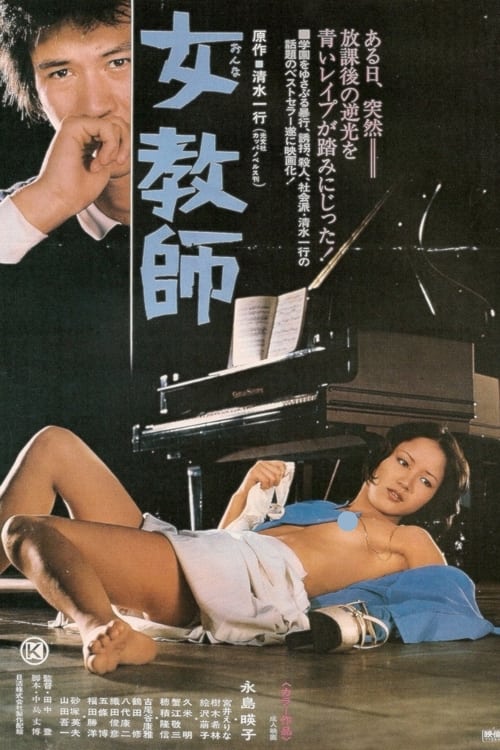
Noboru Tanaka (田中 登, Tanaka Noboru; August 15, 1937 – October 4, 2006) was a Japanese film director known for his Roman Porno films, including three critically respected films known as the Showa trilogy: A Woman Called Sada Abe (aka Sada Abe: Docu-Drama) (1975), Watcher in the Attic (1976), and Beauty's Exotic Dance: Torture! (1977), all three starring Nikkatsu Roman porno queen Junko Miyashita. The first film in this trilogy recounted the story of Sada Abe a year before Nagisa Oshima's internationally released In the Realm of the Senses (1976), which told the same story. Though at the time he was working, his career was overshadowed by directors such as Tatsumi Kumashiro and Chūsei Sone, many critics today judge Tanaka the best of Nikkatsu's Roman porno directors.
Contents
Life and career
Early life
Tanaka was born in Hakuba in Nagano prefecture on August 15, 1937. He majored in French literature at Meiji University in Tokyo. Tanaka said that his interest in the cinema came about through a circuitous route. Early in life he wanted to be a novelist. His interest in writing shifted to poetry. Tanaka remembered, "I wrote a lot of poems. Each expression in a poem may contain countless meanings, otherwise it wouldn't be a good poem. In other words, each expression provides a lot of imagery. Then I thought that in reverse, I could use images to express my poetic world. I thought the image world of film-making might be what I should explore."
While working on his thesis, dealing with this interest in the relationship between imagery and literature, Tanaka took a part-time job at a movie studio to gain first-hand knowledge of film production. He served as a production assistant on Kurosawa's Yojimbo (1961), an experience which created Tanaka's enthusiasm for the film industry. After graduation, he applied to Nikkatsu studios for a job as an assistant director and passed their entrance exam. In this capacity, he worked under some of the studio's best directors of the time, including Seijun Suzuki and Shōhei Imamura. Among the films on which Tanaka worked at this time was Imamura's The Pornographers.
Roman porno
In the late 1960s, Nikkatsu began having severe financial trouble due to audiences lost to television and an influx of Western films. In order to avoid bankruptcy, Takashi Itamochi, president of Nikkatsu, made the decision to put the company's high production values and professional talent into the adult, or pink film industry as a way of attracting a new audience. Nikkatsu called its line of pink films "Roman Porno", and started the series in November 1971. Rather than work in sex films, many directors left the studio at this time, opening up positions for younger directors in their wake. Tanaka remembers his attitude about Nikkatsu's decision, "I was excited and positive about the changes, and was very eager to work in this new genre as a director."
The studio gave its Roman porno directors a great deal of artistic freedom. Beyond budgetary and time restraints, the only rule was that the film meet the official minimum quota of four nude or sex scenes per hour. Patrick Macias notes the diversity of styles this format allowed. Director Chūsei Sone "specialized in ribald tales from the past", Yasuharu Hasebe, "delivered frightening, raw, and violent images", and Tanaka created films which were "as sophisticated as they were erotic." In later years, reflecting on his work in the genre, Tanaka pointed out, "We can look at the core of human beings without disguising anything and can express ourselves very honestly. That's why working on Roman porno is such an enjoyable experience."
Tanaka was given his first chance to direct in 1972 with the early Roman porno, Beads From a Petal. Originally called I Am Burning Up (Moeagaru Watashi), a title Tanaka always preferred, the story deals with the sexual awakening of a frigid woman. Tanaka meant the film to be an allegorical depiction of Japanese society in the post-war years, later saying, "After the war, Japan suffered from frigidity and the film described how the psychological bruises Japan suffered from would gradually be cured as time passed, through a young woman's life." Though criticized for some heavy-handed symbolism, this first film showed Tanaka's ability to give a movie a strikingly interesting look.
The same year, Tanaka directed Night of the Felines, an unusually realistic look at the lives of a group of prostitutes. This is considered one of Tanaka's early major films. Also in 1972, he gained critical approval for his Woman on the Night Train. Even in this early work Tanaka's direction is called, "some of the best in any pink film."
Later years
After a few lean years, Tanaka made a come-back effort with the third entry in the Angel Guts series, the critical and box-office success, Angel Guts: Nami (1980). Jasper Sharp writes that, from the point of character, plotting and construction, Tanaka's film is the most satisfying entry in the series, based on an adult manga by Takashi Ishii. He notes, however, that Tanaka's visuals are over-active make the film a difficult one for most viewers. Tanaka recalled, "I was determined to make a film which was much more impressive than the comic. One image of a film has to be much more impressive than one frame of the comic. That's what film is all about. For the scene in which we see Nami's eye in close-up on the screen, I shot about 3,000 feet of film just to show the details of her eye and [its] movement, including the pulsing of a blood vessel."
After making nearly 25 films for Nikkatsu, Tanaka left the studio to try his hand at directing mainstream films for other studios. He directed several hits including the 1983 Shochiku film, Village of Doom, inspired by the Tsuyama massacre. He returned to Nikkatsu to direct Monster Woman '88 (1988) and then retired from the film industry. Allmovie writes that Tanaka was a director of films "so adventurous and bizarre that he soon became one of Japan's most celebrated directors," while Jasper Sharp judges him, "[t]he most visually-gifted of Nikkatsu's directors of the period." Just as international recognition was beginning to come to Tanaka, he died of a brain aneurysm on October 4, 2006.